
MJ and The Mafia

James Jordan’d Death

A devastating tradic Murder

  • DRAFT

by Doctor Dunkenstin

*** draft date: jun9, 2026

Michael Jordan

Michael Jordan

Man smiling at the camera

Jordan in 201
 

Gambling

During the 1993 NBA playoffs, Jordan was seen gambling in Atlantic City.[359] The previous year, he admitted that he had to cover $57,000 in gambling losses,[360] and author Richard Esquinas wrote a book in 1993 claiming he had won $1.25 million from Jordan on the golf course.[361]

In 2005, Jordan discussed his gambling with Ed Bradley of 60 Minutes and admitted that he made reckless decisions:

Yeah, I’ve gotten myself into situations where I would not walk away and I’ve pushed the envelope. Is that compulsive? Yeah, it depends on how you look at it. If you’re willing to jeopardize your livelihood and your family, then yeah.

When Bradley asked him if his gambling ever got to the level where it jeopardized his livelihood or family, Jordan replied: “No.”[306] David Stern, the commissioner of the NBA, denied in 1995 and 2006 that Jordan’s 1993 retirement was a secret suspension by the league for gambling,[362][363] but the rumor spread widely.[364] In 2010, Ron Shelton, director of Jordan Rides the Bus, said that he began working on the documentary believing that the NBA had suspended him, but that research “convinced [him it] was nonsense”.[364]

Return to the NBA (1995)

The Bulls went 55–27 in 1993–94 without Jordan in the lineup[78] and lost to the New York Knicks in the second round of the playoffs.[135] In March 1995, Jordan decided to quit baseball because he feared he might become a replacement player during the Major League Baseball strike.[136] During the 1994–95 season, Jordan returned to the Bulls midway through the season. On March 18, 1995, Jordan announced his comeback to the NBA in a two-word press release: “I’m back.”[137] The next day, Jordan took to the court with the Bulls to face the Indiana Pacers in Indianapolis, scoring 19 points.[138] The game had the highest Nielsen rating of any regular season NBA game since 1975.[139] Although he could have worn his original number even though the Bulls retired it, Jordan wore No. 45, his baseball number.[138]
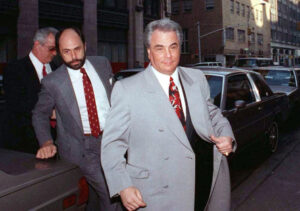
 

In the 1970s, the NBA experienced a significant era defined by a lack of a clear dynasty and a rise in organized crime connections. Because gambling was a foundational pillar of mob revenue, notorious mafia figures, including associates of the New York crime families, attempted to infiltrate the sport to fix games and expand their underground networks. 

The most notable ties between the mob and basketball from this era involve both fixed games and mob debts:

  • The Boston College Point-Shaving Scandal (1978–79): Orchestrated by Lucchese crime family associate Henry Hill and Jimmy Burke, this scheme involved paying Boston College players to manipulate point spreads rather than final outcomes, which successfully evaded detection. 
  • The NBA Referee Allegation: During the same BC point-shaving plot, Hill claimed to have an NBA referee in his pocket who officiated games at Madison Square Garden. The ref had reportedly racked up massive horse-racing debts to the mob. 
  • Jack Molinas: A prominent fixer with deep ties to the Genovese crime family, Molinas heavily influenced the collegiate and professional careers of notable players. While his original collegiate fixing scandal happened prior, Molinas’s heavy involvement in illegal sports betting and subsequent murder in 1975 reflected the dark reach of mob debt in basketball during this period. 

Would you like to know more about the Boston College scandal or other historical


Victor Wembanyama embraced a strict 10-day physical and mental training retreat at China’s historic Shaolin Temple. Guided by 34th-generation warrior monks, the 7’5″ Spurs star meditated for up to 90 minutes at a time, practiced kung fu, and completed challenging night-hikes in total darkness to build emotional resilience

Mafia returns to center stage in NBA betting scandal that included rigged poker games

In the early 1950’s – Gambling was prevalent throughout society.

For professional and college players of the game, there was a lot more money in cheating than playing basketball games. The Mafia took the black hand and almost destroyed the NBA.  Nobody would eventually  watch rigged games.  Eventually, after years of corruption, things changed … but fixing games and lottery picks has reappeared throughout the history of the NBA.

Mafia returns

NEW YORK (AP) — Decades after a crackdown by prosecutors decimated the ranks of the New York Mafia, the indictment of an NBA coach, a player and nearly three dozen others in a betting scandal highlighted the mob’s persistence and adaptability to changing times and technology.

Four of New York’s five organized crime families allegedly participated in the sophisticated rigging of high-stakes poker games that one investigator said were “reminiscent of a Hollywood movie.”

The mobsters are accused of pocketing some of the $7 million that was fleeced from unsuspecting victims who were drawn to poker tables in Las Vegas, Miami, Manhattan and Long Island’s seaside playground for the rich and famous.

Former federal prosecutor Mitchell Epner said the indictments offered a reminder that La Cosa Nostra is “still very real” and that like any organization that has been attacked, “the mob has adjusted.”

Brooklyn case reveals Mafia is less visible but still alive

The mob has shrunk considerably since the days when John Gotti Sr. ran the Gambino family, once one of the most powerful and feared crime organizations in the U.S.

Back then, the dapper Gotti smiled and waved to courthouse spectators, winning the moniker of “The Teflon Don” from New York’s tabloid newspapers after a string of acquittals.

The Mafia and its violent mystique were a cultural phenomenon, featured in films such as “The Godfather” and “Goodfellas,” which paid tribute to a brazen $6 million robbery at Kennedy International Airport, and later in the television hit “The Sopranos.”

In the 1980s, federal prosecutors, including future New York Mayor Rudy Giuliani, launched a crackdown, using racketeering laws that carried life sentences and capitalizing on an erosion of the Mafia’s code of silence.

Dozens of “made men” went to prison, and the mob structure built around social clubs was largely dismantled. Gotti, who was eventually convicted, died of cancer in 2002 while serving a life sentence.

“I’m of a sufficient age to remember Giuliani claiming that organized crime is dead,” said David Shapiro, a former FBI agent and assistant prosecutor who now lectures at New York’s John Jay College of Criminal Justice.

While “the structure has changed, the leadership has changed, the methods of governance have changed, they’re still around because there are still people to be fleeced. It’s just not nearly as a centralized, as open, as organized,” Shapiro said.

There are occasional reminders that the Mafia lingers. Six years ago, the reputed boss of the Gambino family, Francesco “Franky Boy” Cali, was shot to death in front of his Staten Island home. But the mob’s relative lack of visibility does not mean it’s gone away.

Jerry Capeci, an expert on the mob who writes the ganglandnews.com web column, said the Mafia remains a force in the gambling world.

“They’re not as out there as they used to be, and they stopped killing people. But they’re still around,” he said.

Mafia was in familiar territory with corrupt poker games

In the Brooklyn prosecution, the Mafia played a major role in the high-end poker games, with mobsters posing as ordinary players at the tables and providing the muscle to collect debts, prosecutors said.

The victims, including one who lost $1.8 million, were drawn to the games, usually Texas Hold ’Em, that seemed exclusive because former professional athletes played at the tables too.

But federal prosecutors in Brooklyn say the ex-athletes and all the other players were in on a ruse, using technology to rig the outcome.

While there’s no definitive, publicly tracked total number, several notable NBA players have died from drug abuse, with prominent examples including Len Bias and Ricky Berry, tragically highlighting the ongoing issue, but a precise count of all players past and present who died from substance abuse isn’t readily available in aggregate statistics. 
Key Examples:
  • Len Bias: Died in 1986 from cocaine-induced cardiac arrhythmia shortly after being drafted by the Celtics, a pivotal moment that raised awareness about substance abuse in the league.
  • Ricky Berry: Passed away in 1989 from complications related to amphetamine abuse.
  • Haris Brkić: A European player, died in 2000 from gunshot wounds, but substance abuse was a significant factor in his life and death. 
Why a Precise Number is Difficult:
  • Data Collection: The NBA doesn’t widely publish or track this specific statistic for all former players across history.
  • Cause of Death Nuances: Sometimes, drug use contributes to deaths (like heart issues) but isn’t the sole listed cause, making categorization difficult. 
In summary, while specific names like Len Bias stand out, the total number of former NBA players who died due to drug abuse isn’t centrally cataloged, but it’s a recognized, tragic aspect of the league’s history
Scroll To The Top

Chapter 3

HIS NAME IS  Michael

Michael

CHANGED THE HISTORY OF BASKETBALL

The Doctor

Candy and Nuts

Victor Wembanyama Post

Eaten By A Big Red Apple

The Doctor

R.C. Buford – He’s Not Here

Victor Wembanyama Post

Dark Side of the Moon

Victor Wembanyama Post

Wemby The Cricket

Victor Wembanyama Post

Numb and Dumb

Victor Wembanyama Post

In A New York Minute

Victor Wembanyama Post

Ditch Mitch & Burn Big Red

The Doctor

Spring Time In Paris

The Doctor

Faith Prayer & Basketball

Michael Jordan Post

MJ and The Mafia

Victor Wembanyama Post

Put the Lime In The Coconut

NBA

Oscar Daniel Schmidt: Mão Santa

Victor Wembanyama Post

Victor and Joe Barry Read For Success

Stars and Stories

Hugo the Hustler

The Doctor

Phog Allen

NBA

Victor Wembanyama Wikki

Michael Jordan Post

The ‘Dean’ of Basketball

Stars and Stories

Harry Buck Lou