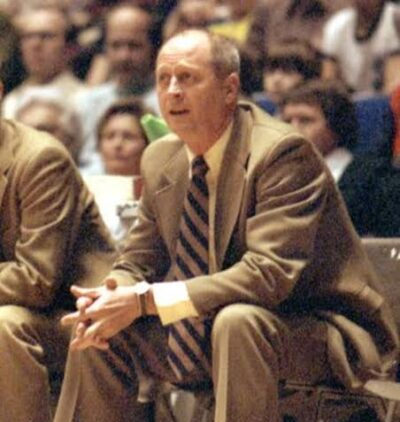

Johnny Orr First In The Door
July 2026 Under Construction
Title: The Phone Call That Changed My Life
Date: June 4, 2026
By: Doctor Dunkenstein
Johnny Orr left the position as Head Basketball Coach at the University of Michigan just as I was about to commit to signing a letter of intent to play under Coach Orr at the University of Michigan, then one phone call changed the path of my life.
To the sadness of my father that I was passing up on a grand once in a lifetime opportunity, I had delayed accepting Michigan’s direct and forthright full scholarship offer made in October of 1979 during my official weekend recruiting visit to the Michigan campus. The entire Michigan basketball staff continued pursuit to recruit me and my long time ties with Coach Orr kept me very close to accepting the opportunity. During the active season I returned to the campus to watch practice and see a home game.
Circumstances during my Senior year in High School led me to verbally commit to putting the ink on the paper and signing a letter of intent. The official signing was to occur on the first date allowed under NCAA rules.
Then, Coach Orr took that phone call from the Iowa State athletic director, … I had not expected the results of that call.
Coach Johnny Orr’s sudden and surprise move to Iowa State in 1980 came about when the Iowa State athletic director called to inquire about Orr’s assistant, Bill Frieder. When Orr learned how much Iowa State was willing to pay Frieder, Orr negotiated the job for himself. Iowa State initially paid Orr $45,000 annually compared to his $33,665 salary at Michigan. Frieder then would succeed Orr at Michigan.
It wasn’t just the difference in the yearly State government coaching salary which made Iowa State’s offer attractive. Just like most programs during that time, it was the money that a coach made from his deals off the court. A major college coach made more money from his summer basketball camp and his weekly radio and television shows than he was paid by the University to coach a basketball team. This has now become known as NIL money in the world of college athletics. Coach Orr’s decision to leave was based on the extremely lucrative financial benefits he would be paid by the outside sources and boosters of a University fan base that was desperate to have a winning basketball program. If Iowa State had had any chance of being immediately successful, I would have joined Coach Orr.
Top college basketball coaches were not rich from their coaching jobs in the 1980’s, who could blame him for trying to better his financial long term existence by accepting a higher paying job at Iowa State. He had no security against being fired by Michigan, The Cyclones were going to give him years of job security to build a program. He clarified all the details to my father, as he tried to convince me that I should attend Iowa State.
Orr left Michigan to become the head coach of the Iowa State Cyclones in 1980, a program that had only one postseason appearance of any sort in school history, when it went to the Final Four in 1944. It took him five years, but just as I knew he was a top NCAA Coach that could take teams to the ‘dance’, place the Iowa State basketball team into the NCAA during the 1985 season.
I was quite aware of Iowa State’s basketball history of the lack of NCAA tournament appearances in the spring of 1979.
Coach Orr immediately pushed hard on me, and tried to convince me to consider Iowa State as a destination basketball program. However, I knew I was not the type of player to carry a team on my back anywhere, let alone the NCAA March Madness Tournament. I was a fundamental facilitator who had a great skill of making a good basketball team run like a Swiss clock. I knew quite well how to play the inside post game and I had a high skill level in the fundamentals. I wanted to play in the NCAA Final Four. This was my one desire and basketball requirement in picking a basketball program for college. My dream was a Final Four with a player appearance of significance in the games. Iowa State was a long way from being invited to the dance with anybody, anywhere. I immediately rejected Coach Orr’s offers.
My attitude toward Bill Frieder, the coached named to replace Johnny Orr at Michigan, continued to pursue me to attend Michigan. Although he was an extremely likable man, I was completely and absolutely convinced he was not a good head College Basketball Coach. I was wrong about that and came to know him much better later in life. Bill was an excellent intelligent and clever basketball coach. I got that wrong.
Orr would go on to lead the Iowa State team to six NCAA Tournaments in his fourteen seasons.
In Orr’s fourth season in Ames, Orr led the Cyclones to the 1984 NIT–only the second postseason appearance of any sort in school history. The following season, he led the Cyclones to their first NCAA Tournament berth in 40 years. The following season, Orr’s Cyclones reached the Sweet Sixteen of the 1986 NCAA Division I men’s basketball tournament with a second round victory over the number five ranked team in the nation, Michigan. Orr claims this was the greatest victory of his career. Orr led Iowa State to four more NCAA tournament berths before retiring from Iowa State in 1994. He remains the winningest coach in Iowa State history with 218 wins.
I knew what a great Coach Johnny Orr was by the age of 16, I had spent many days with him on the basketball court by that age. I knew he would put Iowa State at the top, eventually. I really liked Coach Orr’s personality, his feisty attitude, and his basketball savvy. I was personally in the dumps mentally when it did not work out as I wanted regarding the two of us joining forces on a college basketball court.
My father was also not certain that Michigan would be the place for me under the coaching of Bill Frieder, we agreed upon that, although later I even convinced my Dad we were both wrong in our assessment of Bill, after I came to personally know Coach Frieder during his Arizona State days later in life. He teamed up at ASU with my college coach, Lynn Archibald and put the ‘Sun Devils’ into the national spotlight. Sometimes you get it wrong.
NOTES:
Required written topic editions.
(1) FIRST IN THE DOOR – last to leave, University of Michigan offered me during my first visit to campus, one of many. a.. it was a 2 1/2 hour drive.
(2) HBC 5 years of Cazzie Russel … and Phil Hubbard, five years 4 times every year playing in front of Johnny ...
(2) 1st overnight recruiting trip
(5) Dad and Johnny , two peas in a pod … The pre-arranged Tri-State balcony meeting Dad and Johnny …
(6) Both Navy veterans … Johnny WW II, Dad Korean War, …both Great Depression era babies
After joining the United States Navy for the end of World War II, Orr returned to the college game at Beloit College.
Johnny was born in 1927, my father was born in 1930.
(7) Both lived through and were young boy in the ‘Great Depression”
(8) Both lived through World War two. Both had a sense of humor, and a common view of history.
(6) same everything, war , age … they hit it off,
(10)
***** Coach Orr had arranged to meet my father during the Summer before my Junior year of High school at the HBC basketball Camp at Tri-State University in Angola Indiana … .
Assistants recruit , not head coaches, but Johnny was very active, Bill was very nice but a very nervous and goosey guy… so Dad and I thought … we thought wrong – media hype, we agreed, but, … we were wrong …
(12) My High School Coach was skeptical. He didn’t think I had the talent to play at Michigan. He thought the would bring someone into the program and I would be stuck sitting on the bench. It wasn’t illogical thinking. But, he was wrong about that … … . He never could envision a change in my abilities … … an increase in skill level … I put too much stock in what my High School Coach thought about my potential. He was too much like the coach Norman Dale, in the movie Hoosiers.
That’s part of the reason we never won the Sectional in my four years of High School. He was a great teacher and a very good coach, even a better person, ,,, but everybody makes wrong assessments in basketball players and their futures. He had mine wrong and limited … …
… no pain, no gain, no risk, no reward … he wouldn’t never take risks, … in his life, or his coaching … we never got any team rewards of significance in four years of my high school … ….
Note:
Write about:
… about the Senior year, last game ever in high school, DEFEAT, devastating defeat. against Eastside High School in the Sectional tournament … they beat us with a stall technique, we bet them by 40+ points in the regular season , then .. collapse.
Coach Larry had no response in that game, way too rigid to think outside the box, … … he did not think much of Johnny Orr, he did not know him … very different type of coaching styles ….
Johnny in 1976, big impression on me ,
Phil Hubbard, skatty point guard Ricky Speedy Green, great team ,
I would have fit in,
When I do make it to an NCAA tournament, ( in first years and then again in my actual 2nd year, Larry showed up to those games, … I wasn’t warm to the fact that his assessment of potential in college and my skill was so low, it hindered me … he did not want to hear about that, so, we grew distant …
… a guest of the Doctor’s (name) family, for the 1983 NCAA. I wouldn’t provide tickets, good tickets, only upper seats, … I had to sell my tickets …. created bad blood, ….
Larry Piety visit after Utah … later in Decatur, he was a principal, stopped coaching basketball …, I visited, not a positive conversation, highly critical that I hadn’t joined life, and got my degree …. didn’t understand me playing overseas, … again, limited view … I left with a sour taste
their Mormon son had befriended … doctor Timmy’s Utah ‘foster family;,
Jeannie and Larry Piety were great people, the best of the best, my thing was only about how he hindered my college decisions ..
NOTES:
INTRO: Crossing the Michigan State Line for 3.2 beer, fake I.D. and 6’4″, no questions asked … MICHIGAN 1976
Final four , my objective, … … … fit in all ways, but , ..
:
- FIRST IN THE DOOR – last to leave, University of Michigan offer and also an Iowa State … offer.
- HBC 5 years of Cazzie Russel ,,, five years 4 times every year playing in front of Johnny …
(2) 1st overnight recruiting trip
(5) Dad and Johnny , two peas in a pod … The pre-arranged Tri-State balcony meeting Dad and Johnny …
(6) same everything, war , age … they hit it off.Assistants recruit , not head coaches, but Johnny was active, Bill was goosy .. (Dad thought) ,
(7) the black and white issue
(8) Bill Frieder, didn’t see the real Bill
(9) cut me loose , the Eagles … Joe Walsh …
(10) meeting Bo during the Wisconsin game …
(11) Tears on his cheeks, … my decision … he didn’t say a word … the ride home .
(12) couldn’t say yes
(13) late season , last game, last try, the Angloa visit
(14) Iowas State , no NCAA tournament possibility … not at 32 teams … last try by Johnny
(15) we had 5 years,
(16) weekly lunches, … demonstration of drills, skills, teaching hoops, weekly to me at HBC
(17) he watched … at nights each year …
I regret:
not having a Michigan Degree, with age, yes,
… regret not playing for Johnny Orr, as per Pimm, oh yes, (like an Uncle to me) …
Regrets, yes, do not regret not playing on that black-white Michigan team ,
don’t regret 4 years in Ann Arbor, bad dark dreary weather , compare to UTAH mountains,
might have sat bench at Michigan, So, it goes
Date: July 3, 2026
Title:
By: Doctor Dunkenstein (a.k.a. Christopher Lee Winans)
In the 1980’s the NCAA college athletic regulation and enforcement organization had strict rules regarding recruiting. There was a 60 day period when college coaches could visit your family and hometown. The Head Coaches along with an Assistant Coach of the individual basketball programs would travel to the college basketball prospects town. The visiting coaches had arranged a ‘speed dating’ visiting schedule during August to see as many potential recruits as possible.
Johnny Orr was begin as one of those rapid recruiting introduction visits to my home town in Garrett, Indiana during August of 1979,
While many coaches recruiting me focused on traditional basketball pitches, Johnny Orr built a personal bond with my family over a period of years.
It was a misnomer that Head College Basketball Coaches actually recruited you back in those days. Assistant coaches did the actual recruiting, Head Coaches, for the most part, made telephone calls. They were busy running a basketball team, they visited with you once in the summer for an hour or so, then once again for few hours during your official recruiting trip visit, and they could attend games. In person meetings and conversations were restricted by the NCAA rules book.
Verbal contacts during the season were limited by the NCAA rules and nobody wanted to be turned in the the NCAA for violation of the rules, although rules were often broken by many coaches.
The rule book had hundreds of pages — my father actually read much of it — In reality, you didn’t have a lot of personal contact with Head Coaches recruiting you. But Johnny Orr was different, he contacted my father by phone throughout the recruiting process. Coach Orr was someone I had years of personal experience and hundreds of hours withon the basketball court.
I knew all the Head Basketball Coaches I wanted to play for in college. I had spent countless hours with all of these different coaches during the summer camp sessions for many years, …
My High School coach was skeptical if I could play at Michigan.
The volume of different coaches who put me on the ‘Speed Dating Recruiter List’ for summer time was somewhat overwhelming. My High School Coach began to filter out the visitors. It was a time when everybody from every school in the country tried to get their foot in the door. My recruiting door had a small opening. I had many years of contact with all of the college basketball coaches I wanted to play for, and I was certain that was what I would do, eventually.
In my mind, I was going to play for one of those coaches. They all had one thing in common, they had taken a basketball team to the NCAA Final Four weekend.
I had personal contact and many hours of playing demonstrations over a period of years in front of the coaches I wanted to play for in college. They all knew my basketball skills level and personality well.
My first choice was Dean Smith, I had years of attending the ‘Dean Smith Basketball School’ at the University of North Carolina. But I was not ever going to play as a starter in front of James Worthy or Sam Perkins. The UNC staff went to great lengths to investigate whether I could play the small forward 3 spot. In the end, they selected Matt Dohrety for that position.
I had many years experience and many days of basketball with Johnny Orr of Michigan, he had befriended my father years before he recruited me to play at Michigan. He spent dozens of days with me at the HBC basketball camp. Michigan was my second desired school until a phone call from Iowa State to Johnny Orr ended the possibility of playing for him at Michigan.
Johnny Orr left Michigan to go Coach at Iowa State, he asked me several times to consider Iowa State, but he knew I wanted a school that was going to the NCAA tournament. Iowa States was years from doing that with Coach Orr at the Helm. His replacement, Bill Fieder. was still recruiting me as my Senior season in High School ended, he was not a guy I trusted at that time. I later in life learned that I had completely misjudged Coach Fieder.
I had just survived a demanding week of playing basketball in front of Bobby Knight of Indiana, … … . (read: ‘Bobby The Butt Slapper’) Playing at IU did not seem very enjoyable and I just did not need to join a basketball program that was like the military with a raving General. Not selecting Indiana was made by Knight’s awareness of the misfit of the program to the player. Eventually, he moved on from me …
Rick Majerus, of Marquette – who won the 1977 national Championship – had run the Medalist basketball camps I attended for three years. We talked about Marquette until the week I made my decision to go to Utah. We stayed friends for decades after my time in college.
Lee Rose left Purdue and the coaching profession all together during my Senior year of High School. I think he knew he was leaving before he started recruiting me. I instantly had verbal conflict issues with Gene Keady, and had already signed my letter of intent by the time he became Coach at Purdue.
In my mind, I was going to play for one of those coaches. They all had one thing in common, they had taken a basketball team to the NCAA Final Four weekend.
My basketball program requirements were simple, play in the NCAA final Four. Don’t sit and watch the games in the final four, play.
I knew I wasn’t going to walk into a top programs and take a starting position. But I had excellent team skills and need a place were playing time would be available and starting would be possible in my later college years.
I needed to select a coach and basketball program that was going to make the very limited 32 team invite NCAA Tournament dance list, not the current 2026 year 68 team dance invite list. I had my list of coaches, schools, and teams set, with a few alternative possibilities if things didn’t work out and offers to play were not made by my desired coaches.
Evansville, was about to be coached by Jimmy Crews, Oklahoma was coached by Dave Bliss, a former Knight assistant at IU, and Toledo University, which made the tournament in previous years, had all made me a full scholarship offer before my Senior year in High School.
I maintained contact with all these schools and took recruiting visits to each of these schools. My list had been set before summer started, these August speed dating recruiting events just seemed like it was just going through the motions, until Tracy Tripuka and Jerry Pimm showed up at Garrett, Indiana, prepared to show me how great the Utah basketball program was, how good the educational opportunities would be, how I could fit into a team as a Freshman that was going to have two All-american Senior players in Danny Vranes and Tom Chamberes, and then they pushed me hard to make a visit with my father. During that visit they applied their secret recruiting weapon on me, the Wasatch Mountains and the Grand Canyons of lake Powell.
On my recruiting visit to the school, I felt welcomed and wanted by the players that were a year ahead of me, and I was shown just how much damn fun it was to live as a college student and play in Utah. My eyes were beginning to open soon after the first visit of many visits Tracy Tripuka made to Garrett Indiana..
But Utah was not my first selection because it was 1,500 miles from my family. I was a small town boy.
All the schools and coaches recruiting me were aware of my personal long term relationships with all the other coaches. There was no war, there were no surprises. My list was set.
There would not be any chance at all for under the table deals and rules violations in my recruiting. My High School Coach, Larry Piety was a straight arrow, he always played by the book. Most importantly regarding how my recruitment would be conducted was my father, he was a walking ‘Book of Rules’.
My father was a 25 year District Criminal Prosecutor. He also ran a general law practice. He graduated from the University of Notre Dame Law School in 1957. Nobody broke many rules around him during my lifetime. He also knew when a person was lying, part of his profession. long before my Senior year of High School, I had figured out in life that it was just better to tell my father the truth in a bad situation than to lie about something to his face. He seemed always to have already known the truth about things before issues were discussed, and it was always better to immediately deal with the consequences.
I was close to my father and my eventual decision to attend Utah was only hindered by being 1500 away from him and my family.
Soon after checking Utah out, was quite aware of what Utah had to offer in regards to my basketball requirements. The team was going to a highly ranked team my Freshman year with great Seniors. After those guys moved on to professional careers, there would not be any other upperclassmen big men to play in my position. An opportunity to earn a starting position would avail itself, and my Freshman year offered playing time as a substitute on a great team.
Most of the new basketball coaches who came in to visit me during the speed recruiting sessions, presented themselves as all knowing, prime and proper basketball aficionados, offering instant court time. I wasn’t that naive. If I was going to play as a Freshman starter, your team probably wasn’t very good.
Lorem ipsum dolor
Scroll To The Top
John Michael Orr (June 10, 1927 – December 30, 2013) was an American basketball player and coach, best known as the head coach of men’s basketball at the University of Massachusetts Amherst, University of Michigan, and at Iowa State University. In the 1975–76 season, Orr was named National Coach of the Year.
Early life and playing career
Orr was born in Taylorville, Illinois or Yale, Kansas[1][2][3][4] and grew up in Taylorville during the Great Depression. Orr attended Taylorville High School under coach Dolph Stanley and in his senior year (1944) led the Tornadoes to a state championship and a 45–0 record, the first team to ever finish a season undefeated in the Illinois High School Association’s history.[5] In 2007, Orr was voted one of the “100 Legends of the IHSA Boys Basketball Tournament,” recognizing his superior performance in his appearance in the tournament.[6] After high school Orr went to the University of Illinois and was the youngest freshman to compete in three sports. After joining the United States Navy for the end of World War II, Orr returned to the college game at Beloit College. This reunited him with his high school coach Dolph Stanley, who had come to Beloit College as athletic director, head basketball and football coach.[4]
Orr was initially drafted in 1948 BAA draft by the Minneapolis Lakers of the Basketball Association of America, the precursor to the NBA. Orr did not play for the Lakers, and was again drafted the next year in the 2nd round by the St. Louis Bombers. In 1950, Orr played 21 games for the Bombers before moving to the Waterloo Hawks for 13 more games.
Coaching career
In 1951, Orr was named as head coach at Dubuque Senior High School in Dubuque, Iowa, holding the position until 1959.[4] In 1959, Orr joined the collegiate ranks, becoming an assistant coach at Wisconsin.
UMass
Orr attained his first collegiate head coaching position in 1963 at UMass, where he guided the team to 15–9 record in 1963–64.[4]
Michigan
After three seasons at UMass, Orr moved to the University of Michigan in 1967, serving as an assistant under head coach Dave Strack for one season.
In 1968 Orr was named head coach at Michigan, a position he would hold for 12 seasons. His 1973–74 team made it to the Elite Eight in the NCAA tournament and Orr was named Big Ten Coach of the Year. In 1976, Michigan was the NCAA tournament runner-up (to the undefeated Indiana Hoosiers) and Orr was named National Coach of the Year. His 209 wins were the most in Michigan history until John Beilein passed him in 2017.
Iowa State
Orr left Michigan to become the head coach of the Iowa State Cyclones in 1980, a program that had only one postseason appearance of any sort in school history, when it went to the Final Four in 1944. Orr would go on lead the team to six NCAA Tournaments in 14 seasons. The surprise move to Iowa State in 1980 came about when the Iowa State athletic director called to inquire about Orr’s assistant, Bill Frieder. When Orr learned how much Iowa State was willing to pay Frieder, Orr negotiated the job for himself. Iowa State initially paid Orr $45,000 annually compared to his $33,665 salary at Michigan.[7] Frieder then would succeed Orr at Michigan. In Orr’s fourth season in Ames, Orr led the Cyclones to the 1984 NIT–only the second postseason appearance of any sort in school history. The following season, he led the Cyclones to their first NCAA Tournament berth in 40 years. The following season, Orr’s Cyclones reached the Sweet Sixteen of the 1986 NCAA Division I men’s basketball tournament with a second round victory over the number five ranked team in the nation, Michigan. Orr claims this was the greatest victory of his career. Orr led Iowa State to four more NCAA tournament berths before retiring from Iowa State in 1994. He remains the winningest coach in Iowa State history with 218 wins.
Hilton Coliseum
Orr’s Iowa State teams won 76.7% of their games at Hilton Coliseum. Under Orr, attendance numbers more than doubled from the 6,000 fan average that preceded his arrival. The school band would play the theme from The Tonight Show as Orr entered the arena floor before each game and Orr would give a fist pump to the Iowa State crowd. Orr coached Iowa State to 20 victories over teams ranked in the top 25 at Hilton, with writers coining the term “Hilton Magic.” [7]
Currently at Hilton Coliseum, Iowa State donors have access to “Johnny’s”, a sports bar themed space on the east side of Hilton Coliseum. There are multiple flat-screen TVs as well as food served before the game and snacks served at halftime. Alcoholic beverages are served at the bars. A statue of Johnny Orr sits at the entrance along with cases full of memorabilia from his tenure at Iowa State.
Death
Orr died on December 30, 2013, at the age of 86 at Iowa Methodist Medical Center in Des Moines.[8][9] Orr suffered from complications from a head injury from a fall at home.[10]
Awards and honors
Taylorville High School Hall of Fame (athlete) [11]
1969 – Beloit College Hall of Fame (athlete) [12]
1973 – National Association of Intercollegiate Athletics (NAIA) Hall Of Fame (Athlete) [13]
1973 – Illinois Basketball Coaches Association Hall of Fame [14]
1973–1974 – Big Ten Coach of the Year[15]
1975–1976 – National Association of Basketball Coaches (NABC) National Coach of the Year [16]
1992 – Dubuque Senior High School Hall of Fame [17]
2001 – Iowa State University Hall of Fame [18]
2004 – Des Moines Register Hall of Fame [19]
2011 – Statue erected in Hilton Coliseum[20]
2011– University of Michigan Hall of Honor[21]
Career statistics
| GP | Games played | GS | Games started | MPG | Minutes per game |
| FG% | Field goal percentage | 3P% | 3-point field goal percentage | FT% | Free throw percentage |
| RPG | Rebounds per game | APG | Assists per game | SPG | Steals per game |
| BPG | Blocks per game | PPG | Points per game | Bold | Career high |
Playing career
NBA
Source[22]
Regular season
| Year | Team | GP | FG% | FT% | APG | PPG |
|---|---|---|---|---|---|---|
| 1949–50 | St. Louis | 21 | .362 | .857 | .3 | 1.9 |
| 1949–50 | Waterloo | 13 | .324 | .857 | 1.1 | 4.0 |
| Career | 34 | .339 | .857 | .6 | 2.7 | |
Head coaching record
College
| Season | Team | Overall | Conference | Standing | Postseason | ||||
|---|---|---|---|---|---|---|---|---|---|
| UMass Redmen (Yankee Conference) (1963–1966) | |||||||||
| 1963–64 | UMass | 15–9 | 5–5 | 3rd | |||||
| 1964–65 | UMass | 13–11 | 8–2 | 2nd | |||||
| 1965–66 | UMass | 11–13 | 5–5 | 3rd | |||||
| UMass: | 39–33 | 18–12 | |||||||
| Michigan Wolverines (Big Ten Conference) (1968–1980) | |||||||||
| 1968–69 | Michigan | 13–11 | 7–7 | 4th | |||||
| 1969–70 | Michigan | 10–14 | 5–9 | T–6th | |||||
| 1970–71 | Michigan | 19–7 | 12–2 | 2nd | NIT Quarterfinal | ||||
| 1971–72 | Michigan | 14–10 | 9–5 | T–3rd | |||||
| 1972–73 | Michigan | 13–11 | 6–8 | T–6th | |||||
| 1973–74 | Michigan | 22–5 | 12–2 | T–1st | NCAA Division I Elite Eight | ||||
| 1974–75 | Michigan | 19–8 | 12–6 | 2nd | NCAA Division I First Round | ||||
| 1975–76 | Michigan | 25–7 | 14–4 | 2nd | NCAA Division I Runner-up | ||||
| 1976–77 | Michigan | 26–4 | 16–2 | 1st | NCAA Division I Elite Eight | ||||
| 1977–78 | Michigan | 16–11 | 11–7 | T–4th | |||||
| 1978–79 | Michigan | 15–12 | 8–10 | 6th | |||||
| 1979–80 | Michigan | 17–13 | 8–10 | T–6th | NIT Third Round | ||||
| Michigan: | 209–113 | 120–72 | |||||||
| Iowa State Cyclones (Big Eight Conference) (1980–1994) | |||||||||
| 1980–81 | Iowa State | 9–18 | 2–12 | 8th | |||||
| 1981–82 | Iowa State | 10–17 | 5–9 | 6th | |||||
| 1982–83 | Iowa State | 13–15 | 5–9 | 5th | |||||
| 1983–84 | Iowa State | 16–13 | 6–8 | T–4th | NIT First Round | ||||
| 1984–85 | Iowa State | 21–13 | 7–7 | T–3rd | NCAA Division I First Round | ||||
| 1985–86 | Iowa State | 22–11 | 9–5 | 2nd | NCAA Division I Sweet 16 | ||||
| 1986–87 | Iowa State | 13–15 | 5–9 | 6th | |||||
| 1987–88 | Iowa State | 20–12 | 6–8 | 5th | NCAA Division I First Round | ||||
| 1988–89 | Iowa State | 17–12 | 7–7 | T–4th | NCAA Division I First Round | ||||
| 1989–90 | Iowa State | 10–18 | 4–10 | 6th | |||||
| 1990–91 | Iowa State | 12–19 | 6–8 | 5th | |||||
| 1991–92 | Iowa State | 21–13 | 5–9 | T–6th | NCAA Division I Second Round | ||||
| 1992–93 | Iowa State | 20–11 | 8–6 | T–2nd | NCAA Division I First Round | ||||
| 1993–94 | Iowa State | 14–13 | 4–10 | T–6th | |||||
| Iowa State: | 218–200 | 79–117 | |||||||
| Total: | 466–346 | ||||||||
William Samuel Frieder (born March 3, 1942) is a former basketball coach at Michigan (1981–1989) and Arizona State (1989–1997). Frieder’s 1985–86 team was the last Michigan team to win a Big Ten Championship until the 2011–12 team.
Just before the 1989 NCAA tournament, Frieder announced that he would leave Michigan for Arizona State at the end of the season. Michigan athletic director Bo Schembechler ordered Frieder to leave immediately, and named top assistant Steve Fisher as the interim coach for the tournament. Schembechler famously announced, “A Michigan man will coach Michigan, not an Arizona State man.” The Wolverines went on to win the tournament and Fisher was officially given the head coaching job. Michigan credits the 1988–89 team’s regular season to Frieder and the NCAA tournament to Fisher.
Frieder resigned from Arizona State in 1997 following a point-shaving scandal that involved games from the school’s 1994 season.[1]
Personal
Frieder was born and raised in Saginaw, Michigan and is a 1964 graduate of the University of Michigan’s Ross School of Business.[2]
During the 1990s, Frieder and Lute Olson, then coach of the Arizona Wildcats, participated in a series of television commercials together for Bank One.[3]
Head coaching record
| Season | Team | Overall | Conference | Standing | Postseason | ||||
|---|---|---|---|---|---|---|---|---|---|
| Michigan Wolverines (Big Ten Conference) (1980–1989) | |||||||||
| 1980–81 | Michigan | 19–11 | 8–10 | 7th | NIT Quarterfinal | ||||
| 1981–82 | Michigan | 7–20 | 7–11 | T–7th | |||||
| 1982–83 | Michigan | 15–13 | 7–11 | 9th | |||||
| 1983–84 | Michigan | 23–10 | 11–7 | 4th | NIT Champion | ||||
| 1984–85 | Michigan | 26–4 | 16–2 | 1st | NCAA Division I Second Round | ||||
| 1985–86 | Michigan | 28–5 | 14–4 | 1st | NCAA Division I Second Round | ||||
| 1986–87 | Michigan | 20–12 | 10–8 | 5th | NCAA Division I Second Round | ||||
| 1987–88 | Michigan | 26–8 | 13–5 | 2nd | NCAA Division I Sweet 16 | ||||
| 1988–89 | Michigan | 24–7 | 12–6 | 3rd | fired [a] | ||||
| Michigan: | 188–90 | 102–64 | |||||||
| Arizona State Sun Devils (Pacific-10 Conference) (1989–1997) | |||||||||
| 1989–90 | Arizona State | 15–16 | 6–12 | T–7th | NIT First Round | ||||
| 1990–91 | Arizona State | 20–10 | 10–8 | T–3rd | NCAA Division I Second Round | ||||
| 1991–92 | Arizona State | 19–14 | 9–9 | T–5th | NIT Second Round | ||||
| 1992–93 | Arizona State | 18–10 | 11–7 | T–3rd | NIT First Round | ||||
| 1993–94 | Arizona State | 15–13 | 10–8 | T–4th | NIT First Round | ||||
| 1994–95 | Arizona State | 24–9* | 12–6 | 3rd | NCAA Division I Sweet 16 | ||||
| 1995–96 | Arizona State | 11–16 | 6–12 | 8th | |||||
| 1996–97 | Arizona State | 10–20 | 2–16 | 10th | |||||
| Arizona State: | 130–107** | 66–78 | |||||||
| Total: | 318–197*** | ||||||||