



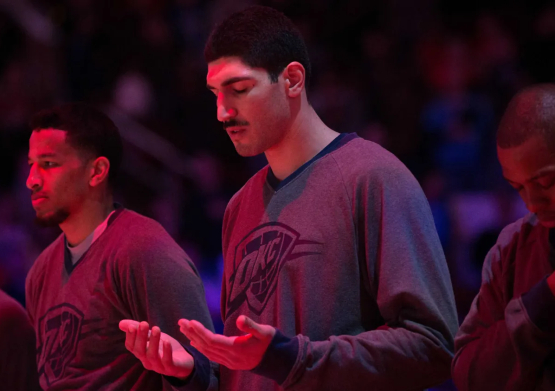
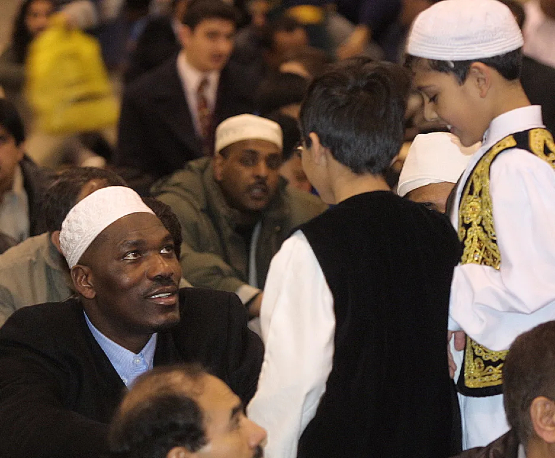
There is a new private room in Madison Square Garden in Manhattan that will be used only on nights the New York Knicks play. It is for Muslim prayer for one of their new players. And there is halal food available for his consumption too.
Enes Kanter, who joined the Knicks in September as part of the Carmelo Anthony trade, appreciates the effort made by the Knicks’ player development and medical staffs.
“I have to pray five times a day, so the Knicks gave me a special room at the practice facility and at Madison Square Garden,” Kanter said. “We have to eat halal food, so they ordered me special food. It means a lot. This is not a Muslim country. But when you see a team do a respectful thing like that, it shows me how respectful people are in America.”
According to the Pew Research Center, by 2020 the United States is expected to have a population that is 78.3 percent Christian and a mere 0.9 percent Muslim. As the NBA season opens Tuesday night, at least 12 of its returning players are Muslim: Kanter, Denver Nuggets forward Kenneth Faried, Minnesota Timberwolves center Gorgui Dieng, Miami Heat guard Dion Waiters, Portland Trail Blazers forward Al-Farouq Aminu and center Jusuf Nurkic, New Orleans Pelicans center Omer Asik, Atlanta Hawks forward Ersan Ilyasova and guard Dennis Schroder, Dallas Mavericks center Salah Mejri, Milwaukee Bucks forward Mirza Teletovic and Brooklyn Nets forward Rondae-Hollis Jefferson, according to the online magazine Muslim Matters and other media outlets.
Perhaps the most famous Muslims to wear an NBA uniform were Hall of Famers Kareem Abdul-Jabbar and Hakeem Olajuwon, as well as Mahmoud Abdul-Rauf, who was suspended by the NBA in 1996 for refusing to stand for the national anthem before Denver Nuggets games.
So, what is it like to be Muslim in the NBA? The Undefeated talked to three current NBA players and four former players, in alphabetical order:
Abdul-Rauf: The Mississippi native first became curious about the Muslim faith while in college at Louisiana State University when his coach, Dale Brown, gave him the book The Autobiography of Malcolm X. During his rookie year with the Nuggets, he was introduced to the Quran and “became hooked” two pages in. He converted to Islam shortly afterward and changed his birth name, Chris Jackson. Abdul-Rauf played in the NBA from 1990-2001 with the Nuggets, Sacramento Kings and Vancouver Grizzlies.
Tariq Abdul-Wahad: The France native became a Muslim in college “after extensive reading while I was looking for the meaning of all things. It offered the proper balance of spirituality, healthy moral way of life, and intellectual approach. It spoke to me in ways nothing else did.” He changed his name from Olivier Saint-Jean. The ex-San Jose State star played in the NBA from 1998-2003 with the Sacramento Kings, Orlando Magic, Denver Nuggets and Dallas Mavericks.
Dieng: The Senegal native was born into a Muslim family led by his father and studied the Quran at a young age. Dieng says that in “Senegal, it’s like 95 percent of the population are Muslim.” The former University of Louisville star center is entering his fifth NBA season with the Timberwolves. The 6-foot-11, 240-pounder averaged 10 points and 7.9 rebounds last season.
Faried: Faried says his father was Christian and his mom was Muslim, which allowed him to learn about both religions as a youngster. He said it was a “no brainer” to decide to be a Muslim when he was around 8 years old, in large part because the Quran preached how to live right, healthy, smart and to give praise to Allah. Faried is entering his seventh NBA season, all with the Nuggets. Nicknamed the “Manimal,” he averaged 9.6 points and 7.6 rebounds last season.
Kenneth Faried of the Denver Nuggets.
Bill Baptist/NBAE via Getty Images
Kanter: Kanter says he was “born Muslim” in Switzerland to a Muslim-faith family originally from Turkey, where the majority of people are Muslim. The 6-foot-11, 245-pounder played for the Utah Jazz and Thunder from 2010-17 and averaged 14.3 points and 6.7 rebounds last season. Kanter said he was stopped in a Romanian airport last May after his passport was canceled by his native Turkey because of his political views and that Turkish President Recep Tayyip Erdogan was responsible.
Olajuwon: Olajuwon says he “was born as a Muslim in Nigeria,” as both of his parents were Muslim and he grew up in an “Islamic environment.” The 12-time NBA All-Star averaged 21.8 points and 11.1 rebounds during his 18-year Hall of Fame career. The 1994 NBA Most Valuable Player also won two NBA championships with the Houston Rockets.
Mustapha Shakur: Shakur says he “was born Muslim” after his then-20-year-old father and 19-year-old mother converted more than 40 years ago in Philadelphia. The former University of Arizona star guard played 22 games for the Washington Wizards during the 2010-11 season and three games for the Thunder in the 2013-14 season. Shakur last played professionally in Germany last season and is a free agent working out in Oakland, California.
What are the challenges of being a Muslim in the NBA in regards to Ramadan and prayer?
Abdul-Rauf: In terms of praying, it was difficult because we traveled a lot, so there are prescribed times when we are to pray. Obviously, there are certain situations you can delay it or make it up. But just trying to find those prayers at those prescribed times were not always easy because you’re sometimes in the air, sometimes you’re practicing or you’re in the process of a game. And also fasting, there are challenges of practicing early and spending all of that energy. Or, playing the game sometimes when you’re playing, it’s time to break at that moment. … Ramadan just takes out of you naturally, but at the same time your body adapts after a certain time.
Dieng: Sometimes it’s tough you know? Like me, before I go to the game I pray at home and just go. But after the game I’m missing the prayer time. Right after the game, usually you will see me in the locker room praying. And I guess some people are wondering like, ‘What is he doing?’ They give you the look. But I do what I believe, and I respect all religions. And when it’s time for me to pray in the locker room or whatever, I got to do what I got to do. That’s my religion.
Faried: It’s very hard because of my illness of asthma and other things that I won’t speak of. I can’t fast, so I have to find another way to give back, and for me it is giving back basically with the temple. … I go there and basically give back and try to figure out ways to do things with the community. Helping homeless, that’s during that time of fasting.
Kanter: Well, of course, you have daily prayers, which you have to do. And the NBA schedule is really difficult with lots of workouts, meetings, traveling, watching game video. So it’s tough, but possible. The same with fasting. I fast while I play, but I just make sure that I live a healthy lifestyle at the same time.
Olajuwon: Of course, there were challenges such as Ramadan taking place during the season and the time to breakfast comes in during the game, or it’s prayer time and you are en route to another city or in the middle of practice or a game. However, the beauty of Islam is that it allows you the ability to meet those challenges by giving a solution to these types of situations. What I mean by that is, Islam is very practical, and it’s not meant to make things difficult for people. For example, as a traveler, you can combine and shorten your afternoon prayers at one time and then your evening prayers at one time, which gives you a sufficient window of time to fulfill your prayer obligations. As for fasting, it is a spiritual mindset that gives you the stamina required to play. Through Allah’s mercy, I always felt stronger and more energetic during Ramadan.
Shakur: The biggest challenge for me personally was making up for my prayers with travel, especially playing in Europe with multiple practices each day. While in the NBA, Ramadan fell on the summer months. And that was difficult because you want to train at a high level, but you don’t have as much energy as well as it being hot in the summer.
What has been the typical reaction from teammates, coaches and executives when they find out you are Muslim?
Abdul-Rauf: Initially, when I became a Muslim, it wasn’t looked at as a threat. … And [people] say they’re Christians or they’re Jews, but you don’t necessarily see them practicing it, according to scripture. So when I first became Muslim, there was nothing. No concern on their faces. But when they saw me, ‘Hold on this guy is actually praying? He’s trying to find a closet and places to pray, talking about fasting.’ You know they had concerns about that, like, ‘I don’t think that’ll be a good thing.’ And, when they see you really trying to practice what you say you’re about, that’s when you start to see a little bit of the resistance, as if though you’re not in this country club atmosphere.
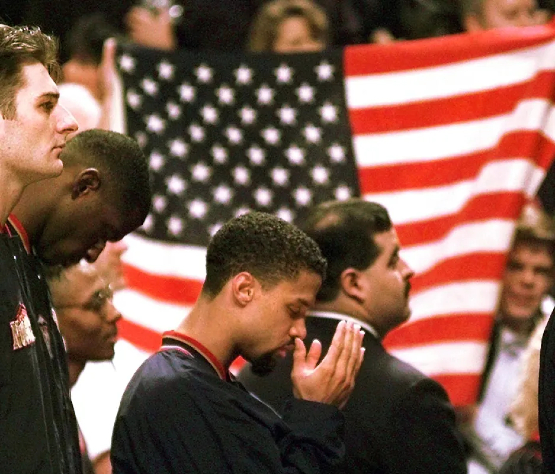
Denver Nuggets guard Mahmoud Abdul-Rauf stands with his teammates and prays during the national anthem.
AP Photo/M. Spencer Green
Abdul-Wahad: At the time, Islam was not yet understood as a universal thing. It was more of a black thing in the U.S., not yet an Arab thing, so it was welcomed with accommodating coaches and staffs. [Then-Orlando Magic head coach] Doc Rivers being the most accommodating made the pregame prayer a silent one instead of the classic Christian prayer on account of me being Muslim. That was big time. As far as Ramadan, same thing. Everybody has always been supportive in NBA organizations.
Dieng: One time at Arizona State as soon as we finished practice at their practice facility, everybody takes a shower. And after showering, ‘Ticket’ (then-teammate Kevin Garnett) was there, K.G. So, we were in the locker room, me and him. So, I was in the shower, I got out and I began praying. So, he was listening to his music while he was taking shower, and I was praying. Soon as he got out the first thing he did was turn the music down. And he waited until when I finished and he was like, ‘Yo, G, I got it. I respect this. I’m sorry. I said, ‘No, no, you’re good. The music doesn’t bother me.’ He’s like, ‘I respect [your religion].’ This means a lot to me, considering the fact that you come here and stick with what you believe. So, some people respect that.
Faried: It’s not really that big of a deal. It’s not as before, where if you’re Muslim coming into the league then you’re looked down upon or disrespected. It’s more so hey, whatever religion you are, it doesn’t matter. … So for me, it doesn’t really matter what you are, it just matters how you play the game. And that’s all they care about.
Kanter: The NBA is like a family; people are respectful of my faith, and the faith of others. The NBA is inclusive, and you can be yourself. Most treat me just like everyone else.
Olajuwon: My teammates, coaches and executives always showed me tremendous respect and regard for my faith. I think it was because they witnessed my growth and maturity along the way due to my beliefs. The Islamic principles are the most upright way of life, and when you practice that, it will reflect in your character.
Have you dealt with any hate or discrimination from teammates, coaches, players or executives?
Abdul-Rauf: Yeah, definitely. But not all of it is overt, especially when you get to that level of the NBA. I think some of it is subtle because there are lawsuits that you can enter into if it becomes just overt and blatant in your face.
Abdul-Wahad: Not openly. But you never know what people are saying behind closed doors. The beauty about Islam is that it puts a certain fear and respect in the heart of people. If you practice the religion the best way you can with a proper understanding, your deeds will echo in ways that trigger respect. So, no, I can’t say I was ever disrespected.
Tariq Abdul-Wahad of the Denver Nuggets in 2000.
Jon Ferrey /Allsport
Faried: I’ve never dealt with it from my teammates or coaches. But general public, yeah. I get it a lot, especially when I start to post that I am Muslim or Eid Mubarak [a Muslim greeting during the holy festivals of Eid al-Fitr and Eid al-Adha]. I posted [online] for that, like, ‘Hey, Eid’s coming up, blessings.’ And people just have so much hate. Like, ‘F your religion.’ Like, ‘You’re a terrorist.’ And I’m like, what? Like, ‘You believe in Allah, and your God’s not real.’ I’m like ‘Wow.’ You get your hate. But you also get your good people commenting back, saying [positive things].
What is the biggest misconception about being Muslim?
Abdul-Rauf: That [Muslims] don’t believe in Jesus. You know what I mean? Some people believe that a lot of Muslims don’t like America, or that Muslims are terrorists. These are misconceptions. Terrorism is antithetical to Islam. You can’t be a terrorist and a Muslim. It’s an oxymoron. And it’s not about, it’s not hating America. I mean, we don’t necessarily agree. There’s no perfect place in the world. But we don’t necessarily agree with all the policies as much of sometimes what we see that takes place in America. So, wherever that is, as a Muslim we’re duty-bound to confront that, to address it. Whether it’s in Saudi Arabia, whether it’s in America, sometimes it comes off as being against the people.
Abdul-Wahad: The biggest misconception is its universality. It is no longer the spiritual quest of a few Bedouin Arabs in the desert. Islam is now a worldwide way of life that has an incredible number of cultural expressions across the globe.
Dieng: The biggest misconception was people thinking Muslims are terrorists. That’s the way they see me nowadays. But I don’t think there is nothing harmful in Islam.
Faried: I guess the radical Muslims. If you believe in Allah, then you’re Muslim. Like, radicals exist. You have your radical Christians, like you have the KKK, who believe in Christianity. Then you have your radical Muslims blowing up buildings and stuff in Allah’s name. It’s just extremes to each side of religion. But you’re always going to have your humble, appreciative people who are just like, ‘Yo, I don’t partake in that type of stuff.’ I just pray and believe in the way of Allah.
Kanter: Well, most people think Muslims are only Arabs. But in fact there are Turks, Russians, Indonesians, Bosnians and Americans, etc., that are Muslim. Many people around the world are Muslims.
Olajuwon: I would say it is probably the ignorance around the religion. Unfortunately, nowadays, people associate Muslims and Islam with terrorism. A lot of people don’t really know the true Islam and the great contributions Islam and Muslims have made to civilization. Islam has a rich history. It is not a new religion that popped up in recent years.
Shakur: The biggest misconception I see today and hear is that a Muslim can’t be flawed too. Islam is seen as a ‘strict’ religion. But in reality, all religion is. But many choose to abide by whatever fits them personally.
Is there a current or former Muslim NBA player who you look up to, and why?
Abdul-Rauf: I really like Hakeem Olajuwon. He’s a very good brother. I definitely believe he loves Islam. He’s philanthropic. He gives. He’s approachable. A very humble brother, man. And I really enjoyed my time spent with him, and not just seeing how connected he was with his trying to enhance his relationship with Allah, but also just trying to put himself in the situation with all of his stardom and praying with people. And that’s what I pride myself on doing, I’m a people’s person. So I really, man, love that brother. Also, [former NBA player] Shareef Abdur-Rahim, he loves Islam. He’s very giving with his wealth.
Abdul-Wahad: Kareem, Hakeem and Mahmoud. Kareem for his wisdom and experience and Hakeem for his sense of humor and his humility. Mahmoud for his intelligence and awareness. His jumper was nice, too. I played in the late ’90s, and it was an honor to sit and share moments with two amazing Muslim brothers like Olajuwon and Abdul-Rauf. I don’t know Kareem personally, but I would love to meet him and pick his brain.
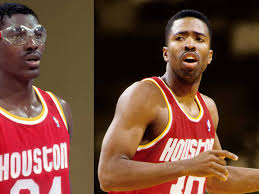
Hakeem Olajuwon (right) of the Houston Rockets blocks a shot attempt by Reggie Lewis of the Boston Celtics.
Nathaniel S. Butler/NBAE via Getty Images
Basketball star Hakeem Olajuwon shakes hands with children during a Eid al-Adha celebration.
David Cooper/Toronto Star via Getty Images
Dieng: I don’t really know who is Muslim or not in this business unless I talk to them. I talked to Kenneth Faried. We spoke, and he told me he was Muslim, I was shocked. I couldn’t see it in him. We were talking about basketball and stuff and so forth, and he was like, ‘I’m Muslim.’ And I was like, what? I said, ‘I didn’t know, you know.’
Faried: I mean, Kareem Abdul-Jabbar. It was great just watching him and Hakeem Olajuwon. Just watching them being great at their sport but also take a stand and say, ‘Hey, I’m Muslim and I’m proud. And I’m going to continue to play this sport, and y’all are gonna respect me for playing this sport and being the religion I am.’ And I’m not gonna say, ‘Oh no, I’m Christian,’ or try to hide my religion from you. I really loved that, and it’s really inspired me. Like you know what, I can be whatever I want.
Olajuwon: Kareem Abdul-Jabbar is really the only Muslim I knew of when I was playing, and I have tremendous respect for him.
Shakur: Hakeem Olajuwon. Some of his years in the NBA, Ramadan fell on in-season months, and I admired his strength to be able to still perform at a high level. The only experience I’ve had in this regard was in high school having fasting occur during the season, and it was difficult. But ironically, I probably played my best during it.
How do you look back on what happened to former Denver Nuggets player Mahmoud Abdul-Rauf for not standing for the national anthem?
Abdul-Wahad: I am an SJSU grad, and athletes as active citizens is second nature to us. A (1968 Olympic gold medalist) Tommie Smith lecture as a sophomore in college took care of that. So yeah, Coach ‘Pop’ [Gregg Popovich] said it best, that ‘this conversation needs to happen, and it needs to be uncomfortable.’ Mahmoud did it when everybody was asleep. He paid with a shortened career. Everybody has to do his part where it’s most uncomfortable. Putting the privileged masses face-to-face with their contradictions and their unfair advantages.
Dieng: People see things differently and act differently. We’re all from different backgrounds and have different personalities. But, me personally, I would never do that. I believe what I believe, and I respect people’s decisions for me or someone else.”
Faried: People disrespected him. He got fined because he didn’t want to stand for the national anthem. It’s actually against our religion, standing for anything. In the national anthem, they’re giving praise to a flag. So most people are like, ‘Yo, we don’t do that.’ And a flag is like, I guess, considered, people say, ‘Oh, the Christian flag of America.’ So, for me, in my religion we don’t give praise to that. We give praise to God, Allah. Like, that’s it, nobody else is higher than him. For me to give praise to a flag is, like, frowned upon.
Kanter: I don’t know much about that, but everyone is allowed to express themselves as they wish. This is the beauty of America. We have that right, whether you agree with it or not, you have the right to protest peacefully. Having these rights in America is something I am proud of.
Olajuwon: Mahmoud was entitled to his opinion, as are the players who are protesting now. They are using their platform to try to make positive change in America, and I hope something good will come of it, God willing.
Shakur: It’s an interesting thing today how relevant it is and how misunderstood he was for it at the time. Much respect for him doing what he felt in his heart and having no regrets. Watching his highlights, I think you can see how special he would have been in the league. But none of that mattered for him. It was about something much bigger than the game.
What is your view on extremist groups who say they are Muslim?
Abdul-Rauf: Islam is about balance, and it’s not about going to extremes. You know whether you’re a Muslim or Christian, whatever, so I’m definitely opposed to extremism in any form.
Abdul-Wahad: People with extreme views in our religion have existed since the time of the prophet. In the mid-seventh century A.D., he warned us about them. They just misunderstand our way of life so enormously that they make grave mistakes. Extremism comes from ignorance and a lack of understanding and knowledge. I always try to remind myself that Islam is the ‘middle way.’ I am here in my country that protects my rights to practice my religion, so I actually and literally have to defend it, if it came to that.
Dieng: People that see it a different way. They’re a different type of Muslim. [There is an Arabic saying] that means believe what you believe.
Gorgui Dieng of the Minnesota Timberwolves.
Andrew D. Bernstein/NBAE via Getty Images
Faried: To me it’s like, ‘Hey, you have extremist Christians.’ So you have debates for both sides. As long as you don’t in a sense try to disrespect my faith and beliefs, like I’m OK with it. I can’t control what you’re doing and what you believe in.
Kanter: It sucks, man. The majority, almost all, Muslims are peaceful. But you have radicals who do stupid things that no Muslims approve of, and they become the face of Muslims in the media. Most Muslims I know donate money to charity and help others. They are good neighbors.
Olajuwon: It is very sad and disheartening to see what is happening in the world today. The Muslims themselves are wondering who these people are because we know this is not what Islam teaches us.
Shakur: Islam is not about violence and destruction. I was never raised that way and was never given that suggestion from anyone. I myself think it’s a clear and evident thing, but most people receive information from noncredible sources. The mistake that is made is grouping everyone together because of the actions of few.
What is your favorite teaching of the Quran?
Abdul-Rauf: [Allah] says he is God the one and only. His Gods are not 0,1,2,3, you know, like a number system. He stands on his own. He said there’s nothing coming before, there’s nothing coming after. … I love the story of Moses, when he was on the journey. He had to go through some trials.
Abdul-Wahad: My favorite Quranic verse is in Surah Ar-Rahman, when God asks repeatedly to mankind, ‘Then which of the blessings of your Lord will you deny?’ The poetic qualities of the verse in the original Arabic are just exquisite. It always reminds me of the many blessings we are all getting on a daily basis. It helps put things in perspective.
Dieng: I learned the Quran at a very young age, and I know the whole book pretty much. When I pray, I don’t need to look at the book. I just start saying it. You memorize it; that way you don’t need it.
Faried: It’s basically the meaning that wipes away evil from around you. Like when I’m having a bad feeling, I’ll be like, ‘La ilaha illallah,’ and that’s basically wiping all the fear in your mind and head, the negativity or people or whatever it is. Say somebody is being mean or something, and you say that, and it’s like, ‘Yo, I’m not worried about you. Praise be to Allah to him to give me strength.’
Kanter: The teachings that you must live for others, to treat everyone with respect and dignity because we are all God’s creation.
Olajuwon: That is a really tough question because there are so many wonderful teachings in the Quran. But if I had to pick just one, I would say it is from Surah 8, Verse 29: ‘Oh, you who believe, if you obey and fear Allah, he will grant you Furqan [criterion to judge between right and wrong] and will expiate for you your sins and forgive you and Allah is the Owner of a Great Bounty.’
What positive influence does being a Muslim have on your life?
Abdul-Rauf: For me it puts everything into perspective. I mean for everything that I do. From the way I worship, to the way I communicate, to the way I give to charity, to the way I look at life. Visiting the elderly. Visiting orphans. It governs everything I do in a positive way.
Abdul-Wahad: The most positive influence Islam had on me is to try to be good and do good for others.
Dieng: It teaches me life. I get where I’m at today because how disciplined I was, and my faith. I believe in God and Muhammad, and I believe the Quran. And I follow everything I read and I see in the Quran, and understand I try to do it. … That’s why I don’t drink alcohol. I don’t party. Just trying to be a good follower.
Faried: Very positive. Basically, gives me strength to go on. To want to go help people. To want to give back and continue to give back and help my family and the community I’m in. Whatever it is. Hey, I live right by giving, not just receiving or trying to. … We forget Christmas is about gifts, and giving and receiving. We don’t have that. Ours is Eid. But Eid is sacrificing, giving up. Like, hey, we don’t eat for a whole day. Why? Because we are giving up the food to give to others that need it.
Kanter: It helps me avoid bad habits and deeds. Instead, I can focus on being a good person and use religion as a map to reaching a better place through serving the community and standing up for justice.
Olajuwon: Being a Muslim gives you structure and discipline in your life. It makes you God-conscious, which regulates all of your actions. Islam is a complete religion which gives you a solution to every situation you may face in life.
Shakur: Understanding that we will all be tested in various ways in our lives and only faith, prayer and focus on the right path can help us. Certain things are ordained to happen, but we have the free will to respond correctly to it.




























Hakeem Olajuwon
 Olajuwon in 2015 | |||||||||||||||
| Personal information | |||||||||||||||
|---|---|---|---|---|---|---|---|---|---|---|---|---|---|---|---|
| Born | January 21, 1963 Lagos, Nigeria | ||||||||||||||
| Nationality | Nigerian / American | ||||||||||||||
| Listed height | 7 ft 0 in (2.13 m) | ||||||||||||||
| Listed weight | 255 lb (116 kg) | ||||||||||||||
| Career information | |||||||||||||||
| High school | Muslim Teachers College (Lagos, Nigeria) | ||||||||||||||
| College | Houston (1981–1984) | ||||||||||||||
| NBA draft | 1984: 1st round, 1st overall pick | ||||||||||||||
| Drafted by | Houston Rockets | ||||||||||||||
| Playing career | 1984–2002 | ||||||||||||||
| Position | Center | ||||||||||||||
| Number | 34 | ||||||||||||||
| Career history | |||||||||||||||
| 1984–2001 | Houston Rockets | ||||||||||||||
| 2001–2002 | Toronto Raptors | ||||||||||||||
| Career highlights | |||||||||||||||
| |||||||||||||||
| Career NBA statistics | |||||||||||||||
| Points | 26,946 (21.8 ppg) | ||||||||||||||
| Rebounds | 13,747 (11.1 rpg) | ||||||||||||||
| Blocks | 3,830 (3.1 bpg) | ||||||||||||||
| Stats at NBA.com | |||||||||||||||
| Stats at Basketball Reference | |||||||||||||||
| Basketball Hall of Fame | |||||||||||||||
| FIBA Hall of Fame | |||||||||||||||
Medals
| |||||||||||||||


Hakeem Abdul Olajuwon[a] (born January 21, 1963), nicknamed “the Dream“, is a Nigerian and American former professional basketball player who played 18 seasons in the National Basketball Association (NBA).[2] A center, he spent a majority of his career with the Houston Rockets and led them to back-to-back NBA championships in 1994 and 1995, before a short stint at the end of his career with the Toronto Raptors. He is widely regarded as one of the greatest centers of all time.[3][4][5]
Born in Lagos, Nigeria, Olajuwon traveled from his home country to play for the University of Houston under head coach Guy Lewis. His college career for the Cougars included three trips to the Final Four. Olajuwon was drafted by the Houston Rockets with the first overall selection of the 1984 NBA draft, a draft well known for its immense talent, which also included players such as Michael Jordan, Charles Barkley, and John Stockton. He combined with the 7-foot-4-inch (224 cm) Ralph Sampson to form a duo dubbed the “Twin Towers”. The two led the Rockets to the 1986 NBA Finals, where they lost in six games to the Boston Celtics. After Sampson was traded to the Golden State Warriors in 1988, Olajuwon became the Rockets’ undisputed leader. He led the league in rebounding twice (1989, 1990) and blocks three times (1990, 1991, 1993).
Despite very nearly being traded during a bitter contract dispute before the 1992–93 season, he remained in Houston. He became the first non-American to be an NBA All-Star and start in an NBA All-Star Game, the first non-American to win the NBA MVP, the first non-American to win NBA Defensive Player of the Year, and in the 1993–94 season, he became and remains the only player in NBA history to win the NBA MVP, Defensive Player of the Year, and Finals MVP awards in the same season. His Rockets won back-to-back championships. The Rockets’ 1994 championship against the New York Knicks was the first in franchise history, with Olajuwon avenging his college championship loss to Patrick Ewing. The following year, after a lackluster regular season, Olajuwon’s Rockets swept Shaquille O’Neal’s Orlando Magic in 4 games in the NBA Finals.
Olajuwon was a member of the 1996 Olympic gold medal-winning United States national basketball team, and was selected as one of the 50 Greatest Players in NBA History. He was inducted into the Naismith Memorial Basketball Hall of Fame in 2008 and the FIBA Hall of Fame in 2016. In October 2021, Olajuwon was honored as one of the league’s greatest players of all time by being named to the NBA 75th Anniversary Team.[6] He ended his career as the league’s all-time leader in blocks (3,830), is one of four NBA players to record a quadruple-double, and is the all-time leader in 5×5 games (when a player has at least 5 points, 5 rebounds, 5 assists, 5 steals and 5 blocks) with six.[7][8]
Early life
Olajuwon was born to Salim and Abike Olajuwon, working-class Yoruba owners of a cement business in Lagos, Nigeria.[9][10] He was the third of eight children. He credits his parents with instilling virtues of hard work and discipline into him and his siblings: “They taught us to be honest, work hard, respect our elders, and believe in ourselves.”[9] Olajuwon has expressed displeasure at his childhood in Nigeria being characterized as backward. “Lagos is a very cosmopolitan city … There are many ethnic groups. I grew up in an environment at schools where there were all different types of people.”[11]
During his youth, Olajuwon was a soccer goalkeeper which helped give him the footwork and agility to balance his size and strength in basketball, and also contributed to his shot-blocking ability.[12] Olajuwon did not play basketball until the age of 15 in high school, when he entered a local tournament while at the Muslim Teachers College in Lagos, Nigeria.[9] It has been said that a coach in Nigeria once asked him to dunk and demonstrated while standing on a chair. Olajuwon then tried to stand on the chair himself. When redirected by staff not to use the chair, he could initially not dunk the basketball.[13]
Despite early struggles, Olajuwon said, “Basketball is something that is so unique. That immediately I pick up the game and, you know, realize that this is the life for me. All the other sports just become obsolete.”[14]
College career
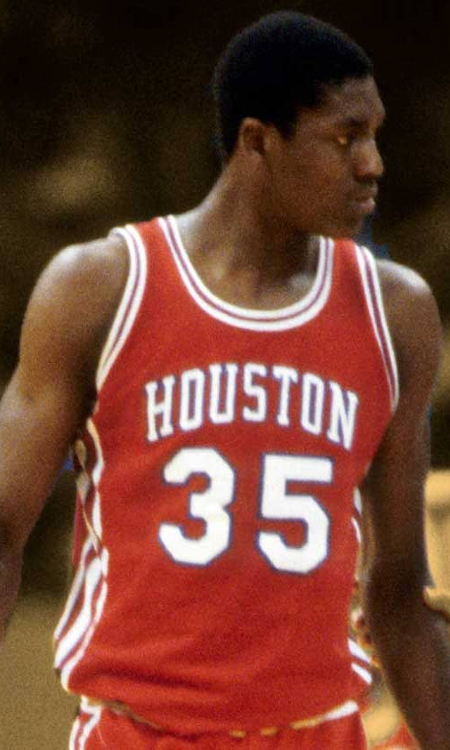
Olajuwon emigrated from Nigeria to play basketball at the University of Houston under Cougars coach Guy Lewis. Olajuwon was not highly recruited and was merely offered a visit to the university to work out for the coaching staff, based on a recommendation from a friend of Lewis who had seen Olajuwon play.[15] He later recalled that when he originally arrived at the airport in 1980 for the visit, no representative of the school was there to greet him. When he called the staff, they told him to take a taxi out to the university.[16]

After redshirting his freshman year in 1980–81 because he could not yet get clearance from the NCAA to play,[11] Olajuwon came mostly off the bench and served as the Cougars’ sixth man as a redshirt freshman in 1981–82, averaging 8.3 points, 6.2 rebounds and 2.5 blocks, shooting 60% from the field in 18 minutes per game as Houston was eliminated in the Final Four by the eventual NCAA champion, North Carolina.[17] Olajuwon sought advice from the coaching staff about how to increase his playing time, and they advised him to work out with local Houston resident and multiple NBA MVP winner, Moses Malone. Malone, who was then a center on the NBA’s Houston Rockets, played games every off-season with several NBA players at the Fonde Recreation Center. Olajuwon joined the workouts and went head to head with Malone in several games throughout the summer. Olajuwon credited this experience with rapidly improving his game: “The way Moses helped me is by being out there playing and allowing me to go against that level of competition. He was the best center in the NBA at the time, so I was trying to improve my game against the best.”[11]
Olajuwon returned from that summer a different player. He was nicknamed “the Dream” during his basketball career after he dunked so effortlessly that his college coach said it “looked like a dream.”[18] He and his teammates (including Clyde Drexler) formed what was dubbed “Phi Slama Jama”, the first slam-dunking “fraternity”, so named because of its above-the-rim prowess. In his sophomore and junior years he helped the Cougars advance to consecutive NCAA championship games, where they lost to North Carolina State on a last-second tip-in in 1983 and a Patrick Ewing-led Georgetown team in 1984. He averaged 13.9 points, 11.4 rebounds, and 5.1 blocks in 1982–83 and 16.8 points, 13.5 rebounds, and 5.6 blocks in 1983–84.[17][19] Olajuwon was voted the NCAA Tournament Most Outstanding Player in 1983,[20] when he was also named the Helms Foundation Player of the Year.[21]
After the 1983–84 season, when he was named a consensus first-team All-American,[19] Olajuwon debated whether to stay in college or declare early for the NBA draft. At that time, before the NBA draft lottery was introduced in 1985, the first pick was awarded by coin flip. Olajuwon recalled: “I really believed that Houston was going to win the coin flip and pick the first draft choice, and I really wanted to play in Houston so I had to make that decision (to leave early).”[16] His intuition proved correct, and the toss placed Houston ahead of the Portland Trail Blazers.
Professional career
Houston Rockets (1984–2001)
Early years (1984–1987)

Olajuwon was selected first overall by the Rockets in the 1984 NBA draft.[22] In his autobiography Living the Dream, Olajuwon mentions an intriguing draft trade offered to the Rockets that would have sent Clyde Drexler and the number two pick in the 1984 NBA draft from Portland in exchange for Ralph Sampson.[23] Had the Rockets made the deal, Olajuwon states the Rockets could have selected Michael Jordan with the number two pick to play alongside Olajuwon and Drexler, who had established chemistry playing together during their Phi Slama Jama days in college. Sportswriter Sam Smith speculates that such a trade “would have changed league history and maybe the entire Michael Jordan legend.”[23] From 1991 to 1998, every NBA championship team included either Jordan or Olajuwon; furthermore, at least one of Drexler, Jordan, and Olajuwon was involved in every NBA Finals from 1990 to 1998.[24]
The Rockets had immediate success during Olajuwon’s rookie season, as their win–loss record improved from a 29–53 record in 1983–84 to 48–34 in 1984–85.[25] He teamed with the 1984 Rookie of the Year, 7 ft 4 in (2.24 m) Ralph Sampson to form the original NBA “Twin Towers” duo. Olajuwon averaged 20.6 points, 11.9 rebounds and 2.68 blocks in his rookie season.[26] He finished as runner-up to Michael Jordan in the 1985 Rookie of the Year voting, and was the only other rookie to receive any votes.
Olajuwon averaged 23.5 points, 11.5 rebounds, and 3.4 blocks per game during his second pro season (1985–86).[26] The Rockets finished 51–31,[25] and advanced all the way to the Western Conference Finals where they faced the defending champion Los Angeles Lakers. The Rockets won the series fairly easily, four games to one, shocking the sports world and landing Olajuwon on the cover of Sports Illustrated. Olajuwon scored 75 points in victories in games three and four, and after the series Lakers coach Pat Riley remarked “We tried everything. We put four bodies on him. We helped from different angles. He’s just a great player.”[27] The Rockets advanced to the 1986 NBA Finals where they lost in six games to the Boston Celtics, whose 1986 team is often considered one of the best teams in NBA history.[28]
On March 10, 1987, Olajuwon came remarkably close to recording the first quintuple-double in NBA history that was tracked. In a dominant performance against the Golden State Warriors, Olajuwon recorded 38 points, 17 rebounds, 12 blocks, 7 steals, and 6 assists. The game is widely regarded as one of the most complete individual efforts in basketball history, showcasing Olajuwon’s rare two-way dominance. While he fell just four assists and three steals short of the unprecedented feat, his performance remains one of the closest any player has ever come to achieving a quintuple-double in an official NBA game.[29]
Mid-career years (1987–1993)
During the 1987–88 season, Sampson (who was struggling with knee injuries that would eventually end his career prematurely) was traded to the Golden State Warriors. The 1988–89 season was Olajuwon’s first full season as the Rockets’ undisputed leader. This change also coincided with the hiring of new coach Don Chaney. The Rockets ended the regular season with a record of 45–37,[25] and Olajuwon finished the season as the league leader in rebounds (13.5 per game) by a full rebound per game over Charles Barkley. This performance was consistent with his averages of 24.8 points and 3.4 blocks.[30] Olajuwon posted exceptional playoff numbers of 37.5 ppg and 16.8 rpg, plus a record for points in a four-game playoff series (150).[31] Nevertheless, the Rockets were eliminated in the first round by the Seattle SuperSonics, 3 games to 1.

The 1989–90 season was a disappointment for the Rockets. They finished the season with a 41–41 record,[25] and though they made the playoffs, were eliminated in four games by Los Angeles. Olajuwon put up one of the most productive defensive seasons by an interior player in the history of the NBA. He won the NBA rebounding crown (14.0 per game) again, this time by an even larger margin; a full two rebounds per game over David Robinson, and led the league in blocks by averaging 4.6 per game.[30] He is the only player since the NBA started recording blocked shots in 1973–74 to average 14+ rebounds and 4.5+ blocked shots per game in the same season. In doing so he joined Kareem Abdul-Jabbar and Bill Walton as the only players in NBA history (at that point) to lead the league in rebounding and shot-blocking in the same season.[31] Olajuwon also recorded a quadruple-double during the season,[32] becoming only the third player in NBA history to do so.
The Rockets finished the 1990–91 season with a record of 52–30[25] under NBA Coach of the Year Chaney. Olajuwon averaged 21.8 points per game in 1990–91, but due to an injury to his eyesocket caused by an elbow from Bill Cartwright,[9] did not play in enough games (56) to qualify for the rebounding title. Otherwise, he would have won it for a third consecutive year, averaging 13.8 a game (league leader Robinson averaged 13.0 rpg). He also averaged a league-leading 3.95 blocks per game.[33][34] However, the Rockets were swept in the playoffs by the LA Lakers.
The following season was a low point for the Rockets during Olajuwon’s tenure. They finished 42–40,[25] and missed the playoffs for the first time in Olajuwon’s career. He missed two weeks early in the season due to an accelerated heartbeat.[35] Despite his usual strong numbers, he could not lift his team out of mediocrity. Since making the Finals in 1986, the Rockets had made the playoffs five times, but their record in those playoff series was 1–5 and they were eliminated in the first round four times. Following the season, Olajuwon requested a trade in part because of his bad contract; his salary was considerably low for a top center, and his contract specifically forbade re-negotiation.[36] He also expressed displeasure with the organization’s efforts to surround him with quality players. He felt the Rockets had cut corners at every turn, and were more concerned with the bottom line than winning.[37] Management had also infuriated Olajuwon during the season when they accused him of faking a hamstring injury because of his unhappiness over his contract situation.[38] His agent cited his differences with the organization as being “irreconcilable”,[39] and Olajuwon publicly insulted owner Charlie Thomas and the team’s front office.[36][40] With the 1992–93 season approaching, a reporter for the Houston Chronicle said that Olajuwon being dealt was “as close to a sure thing as there is.”[41]
Nonetheless, he was not traded and the Rockets began the season with a new coach, Rudy Tomjanovich. Olajuwon improved his passing in 1992–93,[42] setting a new career-high of 3.5 assists per game.[30] This willingness to pass the ball increased his scoring, making it more difficult for opposing teams to double and triple-team him. Olajuwon set a new career-high with 26.1 points per game.[30] The Rockets set a new franchise record with 55 wins,[25] and advanced to the second round of the playoffs, pushing the Seattle SuperSonics to a seventh game before losing in overtime, 103–100. He finished second in the MVP race to Charles Barkley with 22 votes to Barkley’s 59.[43] The team rewarded him with a four-year contract extension toward the end of the regular season.[44]
MVP and championship years (1993–1995)
Olajuwon gained a reputation as a clutch performer and as one of the top centers in history based on his performances in the 1993–94 and 1994–95 seasons.[45] He outplayed centers such as Patrick Ewing, David Robinson, Shaquille O’Neal, and Dikembe Mutombo, and other defensive stalwarts such as Dennis Rodman and Karl Malone. Many of his battles were with his fellow Texas-based rival David Robinson of the San Antonio Spurs.[46] In the 30 head–to–head match-ups during the seven seasons from 1989 to 1996, when both Olajuwon and Robinson were in their primes, Olajuwon averaged 26.3 points per game, shooting 47.6% from the field, while Robinson averaged 22.1 and 46.8%.
Olajuwon led the Rockets to a championship in the 1994 NBA Finals in a seven-game series against the New York Knicks, the team of one of Olajuwon’s perennial rivals since his collegiate days, Patrick Ewing. After being down 2–1, the Knicks took a 3–2 lead into Game 6. The Rockets were defending an 86–84 lead when in the last second, Knicks guard John Starks (who had already scored 27 points) went up for what would have been a Finals-winning three. Olajuwon pulled off a clutch play by blocking the shot as time expired.[47] In Game 7, Olajuwon posted a game–high 25 points and 10 rebounds, which helped defeat the Knicks, bringing the first professional sports championship to Houston since the Houston Oilers won the American Football League championship in 1961. Olajuwon dominated Ewing in their head–to–head match-up, outscoring him in every game of the series and averaging 26.9 points per game on 50% shooting, compared to Ewing’s 18.9 and 36.3%.[48] For his efforts Olajuwon was named NBA Finals Most Valuable Player.
Olajuwon was at the pinnacle of his career. In 1994, he became the only player in NBA history to win the MVP, the Championship, the Finals MVP, and Defensive Player of the Year awards in the same season.[49] He was also the first foreign-born player to win the league’s MVP award.[50]
On December 1, 1994, Olajuwon recorded a triple-double 37 points, 13 rebounds and 12 assists in a 113–109 win over the Golden State Warriors.[51] But despite a slow start by the team, and Olajuwon missing eight games toward the end of the season with anemia,[52] the Rockets repeated as champions in 1995. They were bolstered in part by the acquisition of Clyde Drexler, Olajuwon’s former University of Houston “Phi Slama Jama” teammate, in a mid-season trade from the Portland Trail Blazers. Olajuwon averaged 27.8 points, 10.8 rebounds, and 3.4 blocks per game during the regular season.[33] Olajuwon displayed perhaps the most impressive moments of his career during the playoffs. San Antonio Spurs center David Robinson, recently crowned league MVP, was outplayed by Olajuwon in the Conference Finals: Olajuwon averaged 35.3 points on .560 shooting (Robinson’s numbers were 23.8 and .449) and outscored Robinson 81–41 in the final two games.[53] In the series-clinching game, Olajuwon recorded 39 points, 17 rebounds and 5 blocks.[54] When asked later what a team could do to “solve” Olajuwon, Robinson told LIFE magazine: “Hakeem? You don’t solve Hakeem.”[9] The Rockets won every road game that series. In the NBA Finals, the Rockets swept the Orlando Magic, who were led by a young Shaquille O’Neal. Olajuwon outscored O’Neal in every game,[48] scoring more than 30 points in each and raising his regular-season rate by five while O’Neal’s production dropped by one.[55] Olajuwon was again named Finals MVP. He averaged 33.0 points on .531 shooting, 10.3 rebounds, and 2.81 blocks in the 1995 Playoffs.[9] As in 1994, Olajuwon was the only Rockets All-Star.[56]
Post-championship period (1995–2001)

The Rockets’ two-year championship run ended when they were eliminated in the second round of the 1996 NBA Playoffs by the eventual Western Conference Champion Seattle SuperSonics. Michael Jordan had returned from an 18-month hiatus in March 1995, and his Chicago Bulls dominated the league for the next three years (1996–98). The Bulls and Rockets never met in the NBA Playoffs. The Rockets posted a 57–win season in 1996–97 season when they added Charles Barkley to their roster. They started the season 21–2,[57] but lost the Western Conference Finals in six games to the Utah Jazz. After averaging 26.9 and 23.2 points in 1995–96 and 1996–97 respectively, Olajuwon’s point production dipped to 16.4 in 1997–98.[30] After the Rockets lost in the first round in five games to the Jazz in 1998,[58] Drexler retired. In 1999, the Rockets acquired veteran All-Star Scottie Pippen and finished 31–19 in the lockout-shortened regular season. Olajuwon’s scoring production rose to 18.9 points per game,[30] and he made his twelfth and final All-NBA Team.[31] However, they lost in the first round again, this time to the Lakers.[59] After the season, Pippen was traded to the Portland Trail Blazers.
Toronto Raptors (2001–2002)
Houston began to rebuild, bringing in young guards Cuttino Mobley and 2000 NBA co-Rookie of the Year Steve Francis. On August 2, 2001,[60] after refusing a $13 million deal with the Rockets, Olajuwon was traded to the Toronto Raptors for draft picks (the highest of which was used by Houston to draft Boštjan Nachbar at #15 in the 2002 NBA draft), with the player having a three-year contract that would give him $18 million. In his first game with the Raptors, he scored 11 points in just 22 minutes of playing time against the Magic.[61] Olajuwon averaged career lows of 7.1 points and 6.0 rebounds per game in what would be his final season in the NBA, as he decided to retire in the fall of 2002, due to a back injury.[60][62] Olajuwon retired as the all–time league leader in total blocked shots with 3,830, although shot-blocking did not become an official statistic until the 1973–74 NBA season.
Shortly after his retirement, his No. 34 jersey was retired by the Rockets. For his NBA career, Olajuwon averaged 21.8 points on 51% shooting, 11.1 rebounds, 2.5 assists, and 3.1 blocks in 1,238 career games.[63]
National team career
In 1980, before arriving in the US, Olajuwon played for a Nigerian junior team in the All-Africa Games. This created some problems when he tried to play for the United States men’s national basketball team initially.[64] FIBA rules prohibit players from representing more than one country in international competition, and players must go through a three-year waiting period for any nationality change. Olajuwon was ineligible for selection to the “Dream Team” as he hadn’t become a US citizen.[64]
Olajuwon became a naturalized American citizen on April 2, 1993.[64] For the 1996 Olympics, he received a FIBA exemption and was eligible to play for Dream Team III. The team went on to win the gold medal in Atlanta. During the tournament, he shared his minutes with Shaquille O’Neal and David Robinson. He played 7 out of the 8 games and started 2. He averaged 5 points and 3.1 rebounds and had 8 assists and 6 steals in seven games.
Player profile

If I had to pick a center [for an all-time best team], I would take Olajuwon. That leaves out Shaq, Patrick Ewing. It leaves out Wilt Chamberlain. It leaves out a lot of people. And the reason I would take Olajuwon is very simple: he is so versatile because of what he can give you from that position. It’s not just his scoring, not just his rebounding or not just his blocked shots. People don’t realize he was in the top seven [in NBA history] in steals. He always made great decisions on the court. For all facets of the game, I have to give it to him.
Olajuwon was highly skilled as both an offensive and defensive player. On defense, his rare combination of quickness and strength allowed him to guard a wide range of players effectively. He was noted for both his outstanding shot-blocking ability and his unique talent (for a frontcourt player) for stealing the ball. Olajuwon is the only player in NBA history to record more than 200 blocks and 200 steals in the same season. He averaged 3.09 blocks and 1.75 steals per game for his career.[60] He is the only center to rank among the top ten all-time in steals.[60] Olajuwon was also an outstanding rebounder, with a career average of 11.1 rebounds per game.[60] He led the NBA in rebounding twice, during the 1989 and 1990 seasons. He was twice named the NBA Defensive Player of the Year, and was a five-time NBA All-Defensive First Team selection. In 2022, the NBA renamed its Defensive Player of the Year award as The Hakeem Olajuwon Trophy.[66]
On offense, Olajuwon was famous for his deft shooting touch around the basket and his nimble footwork in the low post. With the ball, Olajuwon displayed a vast array of fakes and spin moves, highlighted in his signature “Dream Shake” (see below). He was a prolific scorer, averaging 21.8 points per game for his career,[9] and an above-average offensive rebounder, averaging 3.3 offensive rebounds per game.[9] Additionally, Olajuwon became a skilled dribbler with an ability to score in “face-up” situations like a perimeter player.[67] He is one of only four players to have recorded a quadruple-double in the NBA, which have only been possible since the 1973–74 season, when blocked shots and steals were first kept as statistics in the NBA. In 2022, to commemorate the NBA’s 75th Anniversary The Athletic ranked their top 75 players of all time, and named Olajuwon as the 11th greatest player in NBA history.[68]
Dream Shake
The best footwork I’ve ever seen from a big man.
— Pete Newell[12]
Olajuwon established himself as an unusually skilled offensive player for a big man, perfecting a set of fakes and spin moves that became known as his trademark Dream Shake. Executed with uncanny speed and power, they are still regarded as the pinnacle of “big man” footwork.[12] Shaquille O’Neal stated: “Hakeem has five moves, then four countermoves – that gives him 20 moves.”[9] Olajuwon himself traced the move back to the soccer-playing days of his youth. “The Dream Shake was actually one of my soccer moves which I translated to basketball. It would accomplish one of three things: one, to misdirect the opponent and make him go the opposite way; two, to freeze the opponent and leave him devastated in his tracks; three, to shake off the opponent and giving him no chance to contest the shot.”[12] The Dream Shake was very difficult to defend, much like Kareem Abdul-Jabbar’s sky-hook.[12]
One notable Dream Shake happened in Game 2 of the 1995 Western Conference Finals against the Spurs. With David Robinson guarding him, Olajuwon performed a cross-over, drove to the basket and faked a layup. Robinson, an excellent defender, kept up with Olajuwon and remained planted. Olajuwon spun counterclockwise and faked a jump shot. Robinson, who was voted the 1995 NBA MVP, fell for the fake and jumped to block the shot. With Robinson in the air, Olajuwon performed an up-and-under move and made an easy layup.[69]
Olajuwon has referred to basketball as a science, and described his signature move in vivid detail: “When the point guard throws me the ball, I jump to get the ball. But this jump is the set-up for the second move, the baseline move. I call it the ‘touch landing.’ The defender is waiting for me to come down because I jumped but I’m gone before I land. Defenders say ‘Wow, he’s quick,’ but they don’t know that where I’m going is predetermined. He’s basing it on quickness, but the jump is to set him up. Before I come down, I make my move. When you jump, you turn as you land. Boom! The defender can’t react because he’s waiting for you to come down to defend you. Now, the first time when you showed that quickness, he has to react to that quickness, so you can fake baseline and go the other way with your jump hook. All this is part of the Dream Shake. The Dream Shake is you dribble and then you jump; now you don’t have a pivot foot. When I dribble I move it so when I come here, I jump. By jumping, I don’t have a pivot foot now. I dribble so now I can use either foot. I can go this way or this way. So he’s frozen, he doesn’t know which way I’m going to go. That is the shake. You put him in the mix and you jump stop and now you have choice of pivot foot. He doesn’t know where you’re gonna turn and when.”[70]
Personal life
Olajuwon married Dalia Asafi on August 8, 1996, in Houston.[71] The couple have four children together.[72] Olajuwon also has an older daughter, Abisola, from a previous relationship with Lita Spencer, whom he met in college. Abisola represented the West Girls in the McDonald’s All-American Game and played in the WNBA.[73] Two of his sons, Abdullah and Abdulrahman, represent Jordan in international basketball, making their debut in the 2025 FIBA Asia Cup.[74] Olajuwon is also a cousin of Nigerian Olympic runner and bobsledder Seun Adigun.[75]
In addition to English, Olajuwon is fluent in French, Arabic, and Yoruba.[50] He wrote his autobiography, Living the Dream, with co-author Peter Knobler in 1996. During his 18-year NBA career, Olajuwon earned more than $110 million in salary.[76]
After Olajuwon’s rookie year he signed a five-year agreement for $2.5 million, to endorse Etonic Shoes with a Signature line, the Dream Shoe. Later in his career, he signed a shoe endorsement deal with LA Gear, and became the face of Spalding’s athletic shoe line and endorsed a sneaker that retailed in various outlets (such as Payless ShoeSource) for $34.99.[77] This made him one of the very few well-known players in any professional sport to endorse a sneaker not from Nike, Reebok, Adidas, or other high-visibility retail brands. As Olajuwon declared: “How can a poor working mother with three boys buy Nikes or Reeboks that cost $120? … She can’t. So kids steal these shoes from stores and from other kids. Sometimes they kill for them.”[78]
Higher education
Attending college was also an important priority for Olajuwon. At the University of Houston, Olajuwon was a physical education major.[79]
Muslim faith
In Olajuwon’s college career and early years in the NBA, he was often undisciplined, talking back to officials, getting into minor fights with other players, and amassing technical fouls. Later, Olajuwon took an active interest in spirituality,[80] becoming a more devout Muslim. On March 9, 1991, he altered his name from Akeem to the more conventional spelling of Hakeem, saying, “I’m not changing the spelling of my name, I’m correcting it”.[81] He later recalled, “I studied the Qur’an every day. At home, at the mosque … I would read it in airplanes, before games and after them. I was soaking up the faith and learning new meanings each time I turned a page. I didn’t dabble in the faith, I gave myself over to it.”[81] “His religion dominates his life”, Drexler said in 1995.[82] Olajuwon was recognized as one of the league’s elite centers even while observing Ramadan (i.e., abstaining from food and drink from dawn to sunset during the lunar month of Ramadan on the Islamic calendar), which occurred during the playing season throughout his career. Olajuwon was noted as sometimes playing better during the month of Ramadan, and in 1995 he was named NBA Player of the Month in February, even though Ramadan began on February 1 of that year.[9][83]
Post-NBA life
Olajuwon played for 20 consecutive seasons in Houston, first collegiately for the University of Houston Cougars and then professionally with the Houston Rockets.[9] He is considered a Houston icon and one of the city’s most beloved citizens.[84] Olajuwon has had great success in the Houston real estate market, with his estimated profits exceeding $100 million. He buys in cash-only purchases, as it is against Islamic law to pay interest.[85] Olajuwon splits his time between Jordan, where he moved with his family to pursue Islamic studies,[12] and his ranch near Houston.
In the 2006 NBA offseason, Olajuwon opened his first Big Man Camp, where he teaches young frontcourt players the finer points of playing in the post. While Olajuwon never expressed an interest in coaching a team, he wishes to give back to the game by helping younger players. When asked whether the league was becoming more guard-oriented and big men were being de-emphasized, Olajuwon responded, “For a big man who is just big, maybe. But not if you play with speed, with agility. It will always be a big man’s game if the big man plays the right way. On defense, the big man can rebound and block shots. On offense, he draws double-teams and creates opportunities. He can add so much, make it easier for the entire team.” He runs the camp for free.[86] Olajuwon has worked with several NBA players, including power forward Emeka Okafor,[87] and center Yao Ming.[88][89] In September 2009, he also worked with Kobe Bryant on the post moves and the Dream Shake.[90] In 2010, Olajuwon worked with Dwight Howard, helping him diversify his post moves and encouraging more mental focus.[91] In the 2011 offseason, LeBron James flew to Houston and spent time working with Olajuwon.[92][93] Olajuwon has also worked with Ömer Aşık, Donatas Motiejūnas, Amar’e Stoudemire, Carmelo Anthony, JaVale McGee, and Kenneth Faried. In an interview with the Sporting News in April 2016, Olajuwon said that Kobe Bryant was his best low-post student. He stated, “I’ve worked with a lot of players, but the one who really capitalized on it the most is Kobe Bryant. When I watch him play, he’ll go down in the post comfortably, naturally, and he’ll execute it perfectly.”[94][95]
Olajuwon was inducted into the Naismith Memorial Basketball Hall of Fame as a member of the class of 2008. On April 10, 2008, the Rockets unveiled a sculpture in honor of him outside the Toyota Center.
Olajuwon attended the 2013 NBA draft to bid farewell to retiring commissioner David Stern as Stern made his announcement for the final pick of the first round. Olajuwon was the first pick announced by Stern back in 1984.[96]
On August 1, 2015, Olajuwon made a special appearance for Team Africa at the 2015 NBA Africa exhibition game.[97] He became a member of the FIBA Hall of Fame in 2016.[98]
Awards and achievements
NBA
- 2× NBA champion (1994, 1995)
- 2× NBA Finals MVP (1994, 1995)
- NBA Most Valuable Player (1994)
- 2× NBA Defensive Player of the Year (1993, 1994)
- 12× NBA All-Star (1985–1990, 1992–1997)
- 6× All-NBA First Team (1987–1989, 1993, 1994, 1997)
- 3× All-NBA Second Team (1986, 1990, 1996)
- 3× All-NBA Third Team (1991, 1995, 1999)
- 5× NBA All-Defensive First Team (1987, 1988, 1990, 1993, 1994)
- 4× NBA All-Defensive Second Team (1985, 1991, 1996, 1997)
- NBA All-Rookie First Team (1985)
- 2× NBA rebounding leader (1989, 1990)
- 3× NBA blocks leader (1990, 1991, 1993)
- IBM Award (1992–93)
- Named one of the 50 Greatest Players in NBA History (1996).
- Named to the NBA 75th Anniversary Team
- No. 34 retired by Houston Rockets
- The NBA Defensive Player of the Year award was renamed The Hakeem Olajuwon Trophy (2022)[99]
USA Basketball
- Olympic Gold Medal (1996)
NCAA
- 2× SWC Regular Season Champion (1983, 1984)
- 2× SWC Tournament Champion (1983, 1984)
- NCAA Final Four Most Outstanding Player (1983)
- Helms Foundation Player of the Year (1983)
- Consensus first-team All-American (1984)
- AP first-team All-American (1984)
- USBWA first-team All-American (1984)
- NABC first-team All-American (1984)
- UPI second-team All-American (1984)
- NCAA rebounding leader (1984)
- SWC Player of the Year (1984)
- First-team All-SWC (1984)
- Second-team All-SWC (1983)
- No. 34 retired by Houston Cougars
Media
- Sporting News NBA MVP (1994)[100]
- Sporting News 1990s NBA All-Decade First Team[101]
- AP 1990s NBA All-Decade Team[102]
Halls of Fame
- Naismith Memorial Basketball Hall of Fame – Class of 2008[103]
- FIBA Hall of Fame – Class of 2016[104]
- Texas Sports Hall of Fame – Class of 1998[105]
- Houston Sports Hall of Fame – Inaugural Class of 2018[106][107]
NBA Records
- Most blocks in NBA history with 3,830[108]
- Most blocks per game in NBA playoff history with 3.26[109]
- Most blocks in a single NBA playoff with 92[110]
- Only player in NBA history to retire in the top eleven all-time in career blocks, points, rebounds, and steals[111]
- Only player in NBA history to record more than 3,000 blocks and 2,000 steals in a career[112]
- Only player in NBA history to record 200 blocks and 200 steals in the same season (1988–89)[113]
- One of four players in NBA history to record a quadruple-double[114]
Media Rankings
- Ranked #10 in ESPN’s All-Time #NBArank: Counting down the greatest players ever (published in 2016)[115]
- Ranked #12 in SLAM Magazine’s 2018 revision of the top 100 greatest players of all time (published in the January 2018 issue)[116]
Career statistics
| GP | Games played | GS | Games started | MPG | Minutes per game |
| FG% | Field goal percentage | 3P% | 3-point field goal percentage | FT% | Free throw percentage |
| RPG | Rebounds per game | APG | Assists per game | SPG | Steals per game |
| BPG | Blocks per game | PPG | Points per game | Bold | Career high |
| † | Won an NBA championship | * | Led the league | ‡ | NBA record |
NBA
Regular season
| Year | Team | GP | GS | MPG | FG% | 3P% | FT% | RPG | APG | SPG | BPG | PPG |
|---|---|---|---|---|---|---|---|---|---|---|---|---|
| 1984–85 | Houston | 82* | 82* | 35.5 | .538 | — | .613 | 11.9 | 1.4 | 1.2 | 2.7 | 20.6 |
| 1985–86 | Houston | 68 | 68 | 36.3 | .526 | — | .645 | 11.5 | 2.0 | 2.0 | 3.4 | 23.5 |
| 1986–87 | Houston | 75 | 75 | 36.8 | .508 | .200 | .702 | 11.4 | 2.9 | 1.9 | 3.4 | 23.4 |
| 1987–88 | Houston | 79 | 79 | 35.8 | .514 | .000 | .695 | 12.1 | 2.1 | 2.1 | 2.7 | 22.8 |
| 1988–89 | Houston | 82* | 82* | 36.9 | .508 | .000 | .696 | 13.5* | 1.8 | 2.6 | 3.4 | 24.8 |
| 1989–90 | Houston | 82* | 82* | 38.1 | .501 | .167 | .713 | 14.0* | 2.9 | 2.1 | 4.6* | 24.3 |
| 1990–91 | Houston | 56 | 50 | 36.8 | .508 | .000 | .769 | 13.8 | 2.3 | 2.2 | 3.9* | 21.2 |
| 1991–92 | Houston | 70 | 69 | 37.7 | .502 | .000 | .766 | 12.1 | 2.2 | 1.8 | 4.3 | 21.6 |
| 1992–93 | Houston | 82 | 82* | 39.5 | .529 | .000 | .779 | 13.0 | 3.5 | 1.8 | 4.2* | 26.1 |
| 1993–94† | Houston | 80 | 80 | 41.0 | .528 | .421 | .716 | 11.9 | 3.6 | 1.6 | 3.7 | 27.3 |
| 1994–95† | Houston | 72 | 72 | 39.6 | .517 | .188 | .756 | 10.8 | 3.5 | 1.8 | 3.4 | 27.8 |
| 1995–96 | Houston | 72 | 72 | 38.8 | .514 | .214 | .724 | 10.9 | 3.6 | 1.6 | 2.9 | 26.9 |
| 1996–97 | Houston | 78 | 78 | 36.6 | .510 | .313 | .787 | 9.2 | 3.0 | 1.5 | 2.2 | 23.2 |
| 1997–98 | Houston | 47 | 45 | 34.7 | .483 | .000 | .755 | 9.8 | 3.0 | 1.8 | 2.0 | 16.4 |
| 1998–99 | Houston | 50* | 50* | 35.7 | .514 | .308 | .717 | 9.6 | 1.8 | 1.6 | 2.5 | 18.9 |
| 1999–00 | Houston | 44 | 28 | 23.8 | .458 | .000 | .616 | 6.2 | 1.4 | .9 | 1.6 | 10.3 |
| 2000–01 | Houston | 58 | 55 | 26.6 | .498 | .000 | .621 | 7.4 | 1.2 | 1.2 | 1.5 | 11.9 |
| 2001–02 | Toronto | 61 | 37 | 22.6 | .464 | .000 | .560 | 6.0 | 1.1 | 1.2 | 1.5 | 7.1 |
| Career | 1,238 | 1,186 | 35.7 | .512 | .202 | .712 | 11.1 | 2.5 | 1.7 | 3.1 | 21.8 | |
| All-Star | 12 | 8 | 23.2 | .409 | 1.000 | .520 | 7.8 | 1.4 | 1.3 | 1.9 | 9.8 | |
Playoffs
| Year | Team | GP | GS | MPG | FG% | 3P% | FT% | RPG | APG | SPG | BPG | PPG |
|---|---|---|---|---|---|---|---|---|---|---|---|---|
| 1985 | Houston | 5 | 5 | 37.4 | .477 | — | .1000 | 13.0 | 1.4 | 1.4 | 2.6 | 21.2 |
| 1986 | Houston | 20 | 20 | 38.3 | .530 | .000 | .638 | 11.8 | 2.0 | 2.0 | 3.5 | 26.9 |
| 1987 | Houston | 10 | 10 | 38.9 | .615 | .000 | .742 | 11.3 | 2.5 | 1.3 | 4.3 | 29.2 |
| 1988 | Houston | 4 | 4 | 40.5 | .571 | .000 | .884 | 16.8 | 1.8 | 2.3 | 2.8 | 37.5 |
| 1989 | Houston | 4 | 4 | 40.5 | .519 | — | .680 | 13.0 | 3.0 | 2.5 | 2.8 | 25.3 |
| 1990 | Houston | 4 | 4 | 40.3 | .443 | — | .706 | 11.5 | 2.0 | 2.5 | 5.8 | 18.5 |
| 1991 | Houston | 3 | 3 | 43.0 | .578 | .000 | .824 | 14.7 | 2.0 | 1.3 | 2.7 | 22.0 |
| 1993 | Houston | 12 | 12 | 43.2 | .517 | .000 | .827 | 14.0 | 4.8 | 1.8 | 4.9 | 25.7 |
| 1994† | Houston | 23 | 23 | 43.0 | .519 | .500 | .795 | 11.0 | 4.3 | 1.7 | 4.0 | 28.9 |
| 1995† | Houston | 22 | 22 | 42.2 | .531 | .500 | .681 | 10.3 | 4.5 | 1.2 | 2.8 | 33.0 |
| 1996 | Houston | 8 | 8 | 41.1 | .510 | .000 | .725 | 9.1 | 3.9 | 1.9 | 2.1 | 22.4 |
| 1997 | Houston | 16 | 16 | 39.3 | .590 | .000 | .731 | 10.9 | 3.4 | 2.1 | 2.6 | 23.1 |
| 1998 | Houston | 5 | 5 | 38.0 | .394 | .000 | .727 | 10.8 | 2.4 | 1.0 | 3.2 | 20.4 |
| 1999 | Houston | 4 | 4 | 30.8 | .426 | — | .875 | 7.3 | 0.5 | 1.3 | 0.8 | 13.3 |
| 2002 | Toronto | 5 | 0 | 17.2 | .545 | — | .667 | 3.8 | 0.4 | 1.4 | 0.8 | 5.6 |
| Career | 145 | 140 | 39.6 | .528 | .222 | .719 | 11.2 | 3.2 | 1.7 | 3.3‡ | 25.9 | |
College
| Year | Team | GP | GS | MPG | FG% | 3P% | FT% | RPG | APG | SPG | BPG | PPG | |
|---|---|---|---|---|---|---|---|---|---|---|---|---|---|
| 1981–82 | Houston | 29 | 6 | 18.2 | .607 | .000 | .563 | 6.2 | .4 | .9 | 2.5 | 8.3 | |
| 1982–83 | Houston | 34 | 34 | 27.4 | .611 | .000 | .595 | 11.4 | .9 | 1.4 | 5.1 | 13.9 | |
| 1983–84 | Houston | 37 | 37 | 34.1 | .675 | .000 | .526 | 13.5 | 1.3 | 1.6 | 5.6 | 16.8 | |
| Career | 100 | 77 | 27.2 | .639 | .000 | .555 | 10.7 | .9 | 1.3 | 4.5 | 13.3 | ||
Source:[117]
See also
- List of NBA career scoring leaders
- List of NBA franchise career scoring leaders
- List of NBA career rebounding leaders
- List of NBA career steals leaders
- List of NBA career blocks leaders
- List of NBA career turnovers leaders
- List of NBA career personal fouls leaders
- List of NBA career free throw scoring leaders
- List of NBA career games played leaders
- List of NBA career minutes played leaders
- List of NBA career playoff scoring leaders
- List of NBA career playoff rebounding leaders
- List of NBA career playoff steals leaders
- List of NBA career playoff blocks leaders
- List of NBA career playoff turnovers leaders
- List of NBA career playoff free throw scoring leaders
- List of NBA annual rebounding leaders
- List of NBA annual blocks leaders
- List of NBA single-game blocks leaders
- List of NBA single-season blocks per game leaders
- List of NCAA Division I men’s basketball season rebounding leaders
- Islam in Houston
Notes
- English: /həˈkiːm əˈlaɪʒu.ɒn/ hə-KEEM ə-LY-zhoo-on,[1] Yoruba: [ɔ̄lád͡ʒùwɔ̃̀] ⓘ.
Referen